
Toolkit · free to read
Still Here.
Your personal toolkit for navigating hard times
Grounding, safety-planning and staying — made from clinical and lived experience, for the days that feel unliveable. It was written to be carried, dog-eared, returned to. Read it here as often as you need; nothing is gated and nothing is asked of you first.
18 pages · free to read, no sign-up
STILL HERE.
Copyrighted: Soft Spaces Therapy · Meghna Prakash · 2026
meg@softspacestherapy.in· softspacestherapy.in
Your Personal Toolkit for Navigating
Hard Times
Facilitated by Soft Spaces Therapy
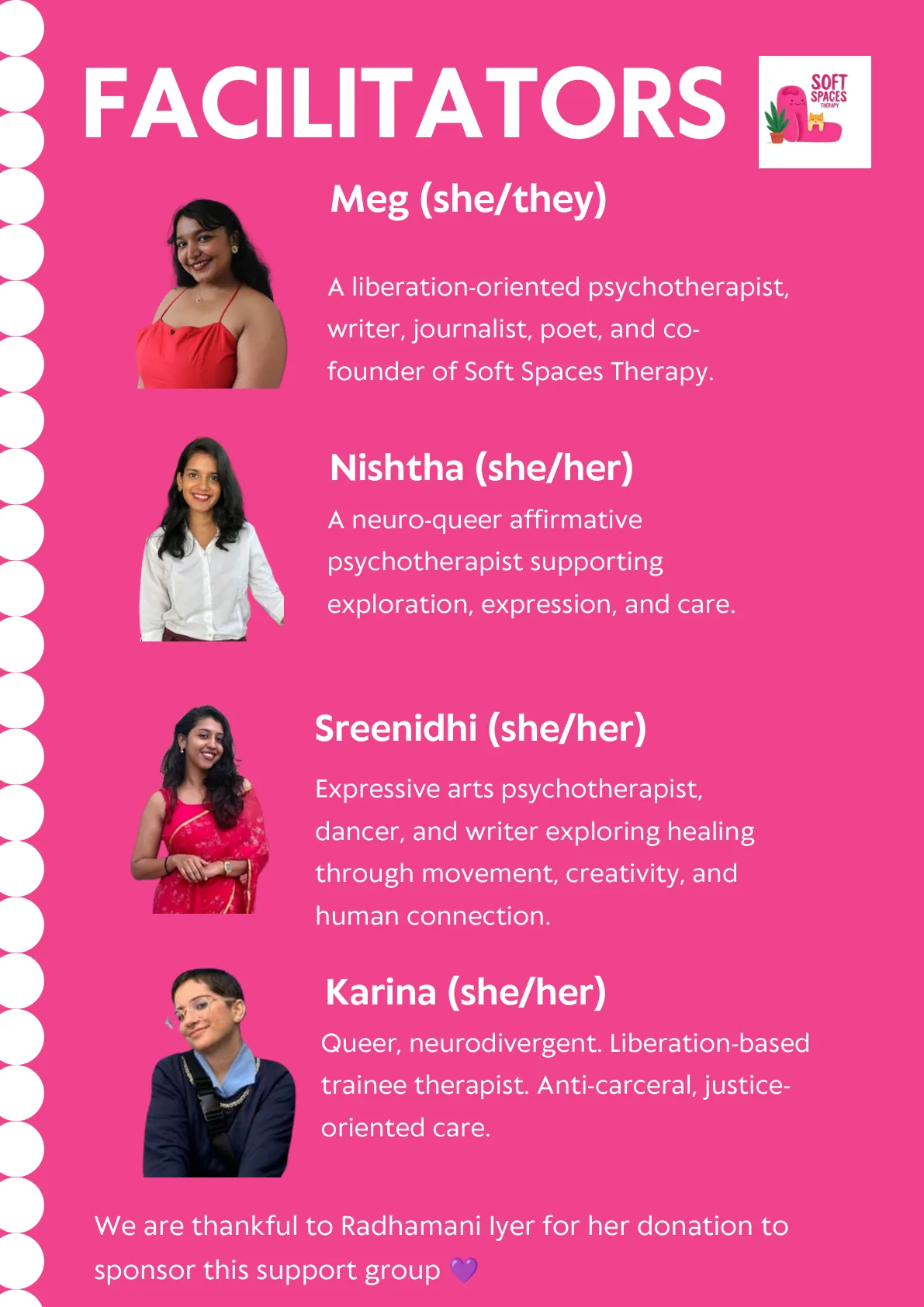
FACILITATORS
Meg (she/they)
A liberation-oriented psychotherapist,
writer, journalist, poet, and co-
founder of Soft Spaces Therapy.
Nishtha (she/her)
A neuro-queer affirmative
psychotherapist supporting
exploration, expression, and care.
Sreenidhi (she/her)
Expressive arts psychotherapist,
dancer, and writer exploring healing
through movement, creativity, and
human connection.
We are thankful to Radhamani Iyer for her donation to
sponsor this support group 💜
Karina (she/her)
Queer, neurodivergent. Liberation-based
trainee therapist. Anti-carceral, justice-
oriented care.
Soft Spaces Therapy · softspacestherapy.in
Navigating the Toolkit
1. YOUR NERVOUS SYSTEM IS NOT BROKEN
2. RIGHT NOW — IMMEDIATE GROUNDING
3. SOUND & MOVEMENT
5.NARRATIVE THERAPY & IFS — YOUR INNER WORK
4.EFT TAPPING — A COMPLETE GUIDE
6. ART PRACTICES
7.WHEN EVERYTHING FEELS LIKE TOO MUCH
8.COMMUNITY AND RESOURCES
This booklet belongs to you.
It was made to be carried, dog-eared, drawn in, returned to. The tools here are evidence-based, trauma-
informed, and grounded in queer liberation psychology. They work on a Tuesday commute, in a
bathroom break, at 2am — not just in a therapy room.
You don't need to be in crisis to use them. You don't need to explain yourself to use them. You just need
to be here. And you are.
When you feel overwhelmed, shut down, hypervigilant, or dissociated —
your nervous system is not malfunctioning. It is doing exactly what it was
designed to do: protect you.
Dr. Stephen Porges' Polyvagal Theory identifies three states our nervous
system moves through:
SAFE & SOCIAL (Ventral Vagal) — Connected, curious, regulated. This is
where healing happens.
MOBILISED (Sympathetic) — Alert, anxious, fight-or-flight. High activation —
ready for action.
SHUTDOWN (Dorsal Vagal) — Numb, collapsed, frozen. The body's last-resort
protection.
Minority stress — the chronic pressure of existing in a world that actively
legislates against your identity — keeps the nervous system in the upper two
states far more than it should. The tools in this booklet help you find your
way back to the first.
The Window of Tolerance
Your 'window' is the zone where you can feel your feelings and still function.
Trauma, grief, and systemic stress narrow this window. These tools widen it
— gently, over time.
STILL HERE.
1. YOUR NERVOUS SYSTEM IS NOT BROKEN
Soft Spaces Therapy · Meghna Prakash · 2026
meg@softspacestherapy.in· softspacestherapy.in
Your Personal Toolkit for Navigating Hard Times
Soft Spaces Therapy · softspacestherapy.in
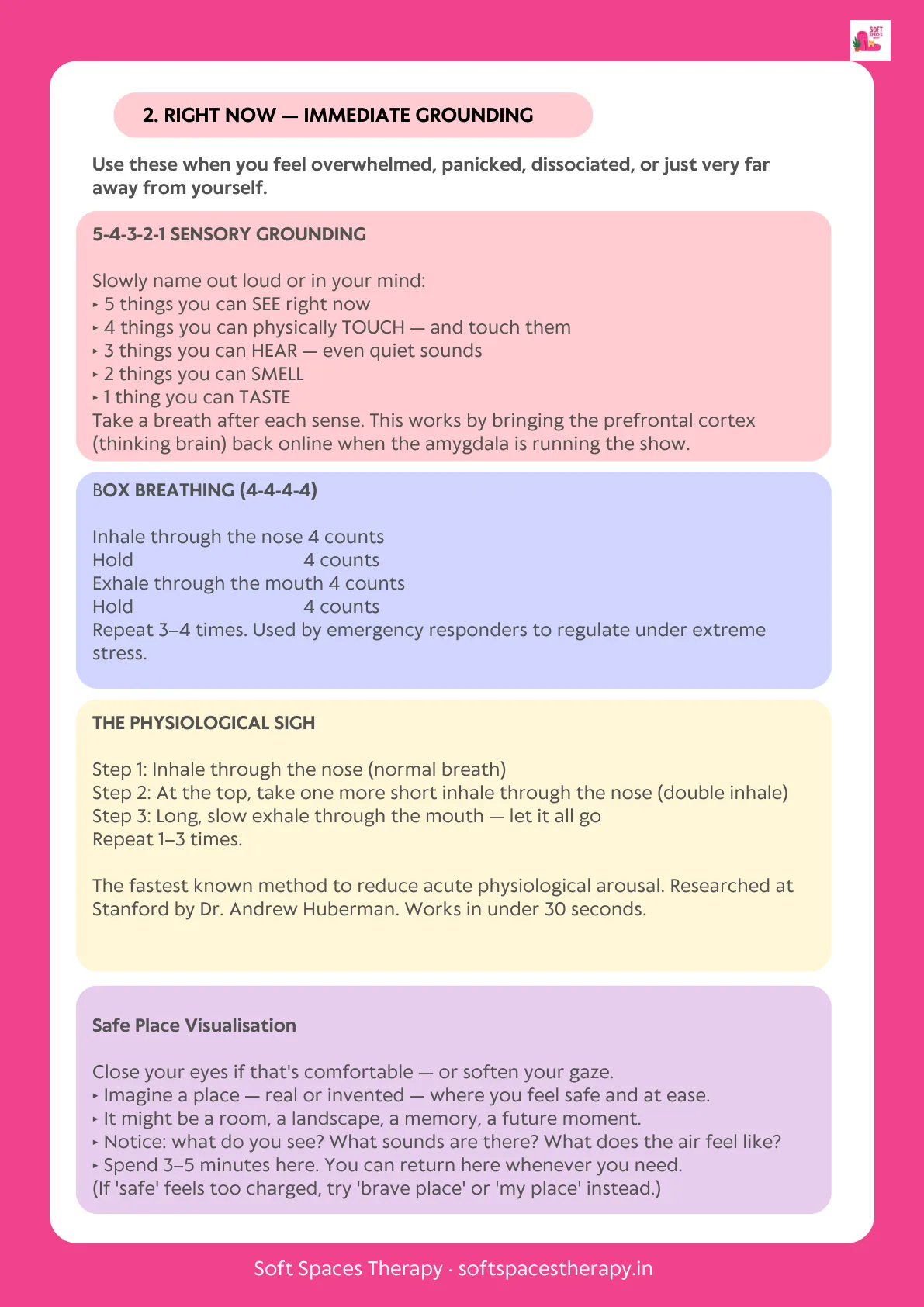
Use these when you feel overwhelmed, panicked, dissociated, or just very far
away from yourself.
5-4-3-2-1 SENSORY GROUNDING
Slowly name out loud or in your mind:
▸ 5 things you can SEE right now
▸ 4 things you can physically TOUCH — and touch them
▸ 3 things you can HEAR — even quiet sounds
▸ 2 things you can SMELL
▸ 1 thing you can TASTE
Take a breath after each sense. This works by bringing the prefrontal cortex
(thinking brain) back online when the amygdala is running the show.
BOX BREATHING (4-4-4-4)
Inhale through the nose 4 counts
Hold 4 counts
Exhale through the mouth 4 counts
Hold 4 counts
Repeat 3–4 times. Used by emergency responders to regulate under extreme
stress.
THE PHYSIOLOGICAL SIGH
Step 1: Inhale through the nose (normal breath)
Step 2: At the top, take one more short inhale through the nose (double inhale)
Step 3: Long, slow exhale through the mouth — let it all go
Repeat 1–3 times.
The fastest known method to reduce acute physiological arousal. Researched at
Stanford by Dr. Andrew Huberman. Works in under 30 seconds.
Safe Place Visualisation
Close your eyes if that's comfortable — or soften your gaze.
▸ Imagine a place — real or invented — where you feel safe and at ease.
▸ It might be a room, a landscape, a memory, a future moment.
▸ Notice: what do you see? What sounds are there? What does the air feel like?
▸ Spend 3–5 minutes here. You can return here whenever you need.
(If 'safe' feels too charged, try 'brave place' or 'my place' instead.)
2. RIGHT NOW — IMMEDIATE GROUNDING
Soft Spaces Therapy · softspacestherapy.in
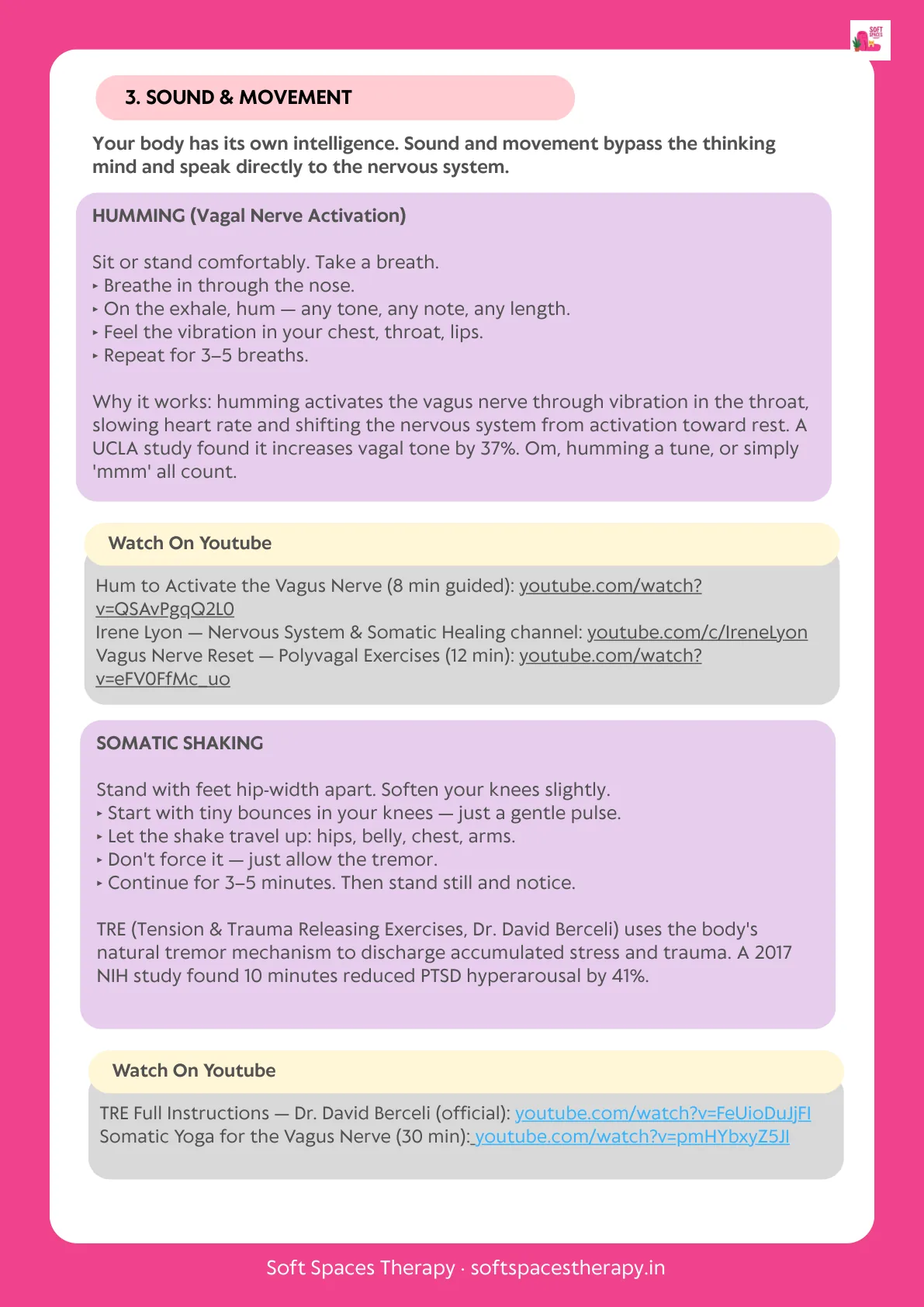
Your body has its own intelligence. Sound and movement bypass the thinking
mind and speak directly to the nervous system.
3. SOUND & MOVEMENT
HUMMING (Vagal Nerve Activation)
Sit or stand comfortably. Take a breath.
▸ Breathe in through the nose.
▸ On the exhale, hum — any tone, any note, any length.
▸ Feel the vibration in your chest, throat, lips.
▸ Repeat for 3–5 breaths.
Why it works: humming activates the vagus nerve through vibration in the throat,
slowing heart rate and shifting the nervous system from activation toward rest. A
UCLA study found it increases vagal tone by 37%. Om, humming a tune, or simply
'mmm' all count.
Hum to Activate the Vagus Nerve (8 min guided): youtube.com/watch?
v=QSAvPgqQ2L0
Irene Lyon — Nervous System & Somatic Healing channel: youtube.com/c/IreneLyon
Vagus Nerve Reset — Polyvagal Exercises (12 min): youtube.com/watch?
v=eFV0FfMc_uo
Watch On Youtube
SOMATIC SHAKING
Stand with feet hip-width apart. Soften your knees slightly.
▸ Start with tiny bounces in your knees — just a gentle pulse.
▸ Let the shake travel up: hips, belly, chest, arms.
▸ Don't force it — just allow the tremor.
▸ Continue for 3–5 minutes. Then stand still and notice.
TRE (Tension & Trauma Releasing Exercises, Dr. David Berceli) uses the body's
natural tremor mechanism to discharge accumulated stress and trauma. A 2017
NIH study found 10 minutes reduced PTSD hyperarousal by 41%.
TRE Full Instructions — Dr. David Berceli (official): youtube.com/watch?v=FeUioDuJjFI
Somatic Yoga for the Vagus Nerve (30 min): youtube.com/watch?v=pmHYbxyZ5JI
Watch On Youtube
Soft Spaces Therapy · softspacestherapy.in
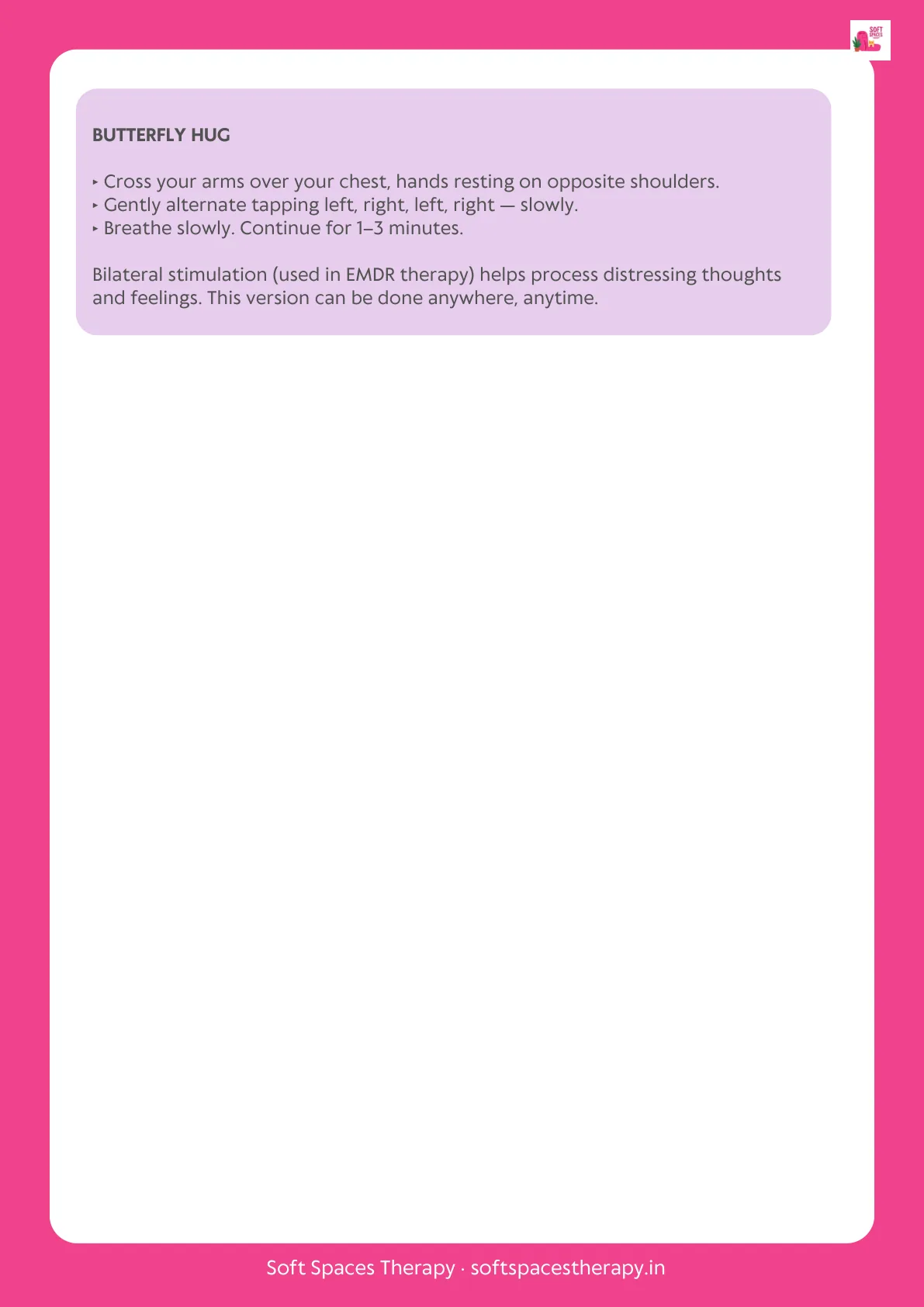
BUTTERFLY HUG
▸ Cross your arms over your chest, hands resting on opposite shoulders.
▸ Gently alternate tapping left, right, left, right — slowly.
▸ Breathe slowly. Continue for 1–3 minutes.
Bilateral stimulation (used in EMDR therapy) helps process distressing thoughts
and feelings. This version can be done anywhere, anytime.
Soft Spaces Therapy · softspacestherapy.in
4.EFT TAPPING — A COMPLETE GUIDE
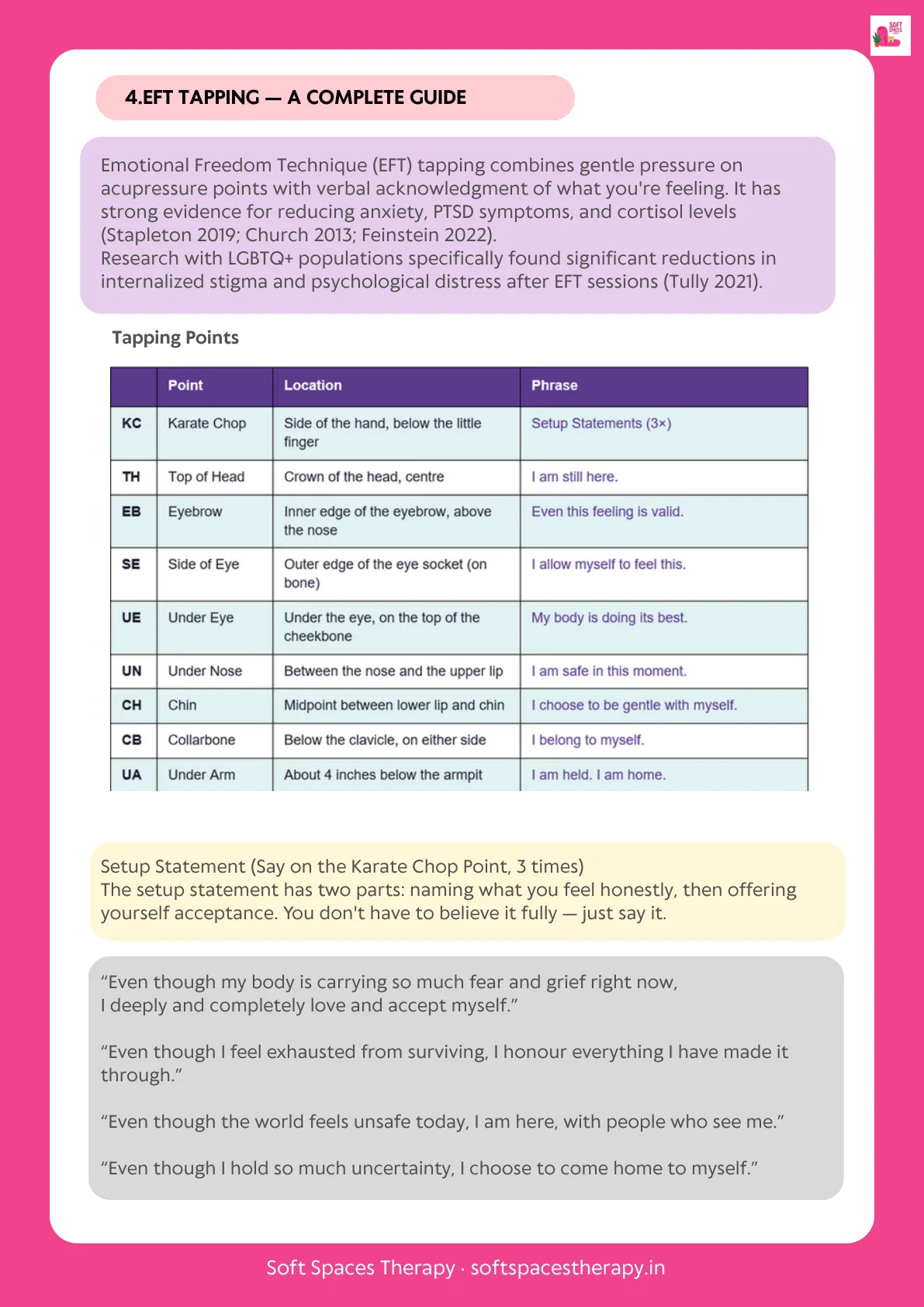
Emotional Freedom Technique (EFT) tapping combines gentle pressure on
acupressure points with verbal acknowledgment of what you're feeling. It has
strong evidence for reducing anxiety, PTSD symptoms, and cortisol levels
(Stapleton 2019; Church 2013; Feinstein 2022).
Research with LGBTQ+ populations specifically found significant reductions in
internalized stigma and psychological distress after EFT sessions (Tully 2021).
Setup Statement (Say on the Karate Chop Point, 3 times)
The setup statement has two parts: naming what you feel honestly, then offering
yourself acceptance. You don't have to believe it fully — just say it.
Soft Spaces Therapy · softspacestherapy.in
Tapping Points
“Even though my body is carrying so much fear and grief right now,
I deeply and completely love and accept myself.”
“Even though I feel exhausted from surviving, I honour everything I have made it
through.”
“Even though the world feels unsafe today, I am here, with people who see me.”
“Even though I hold so much uncertainty, I choose to come home to myself.”
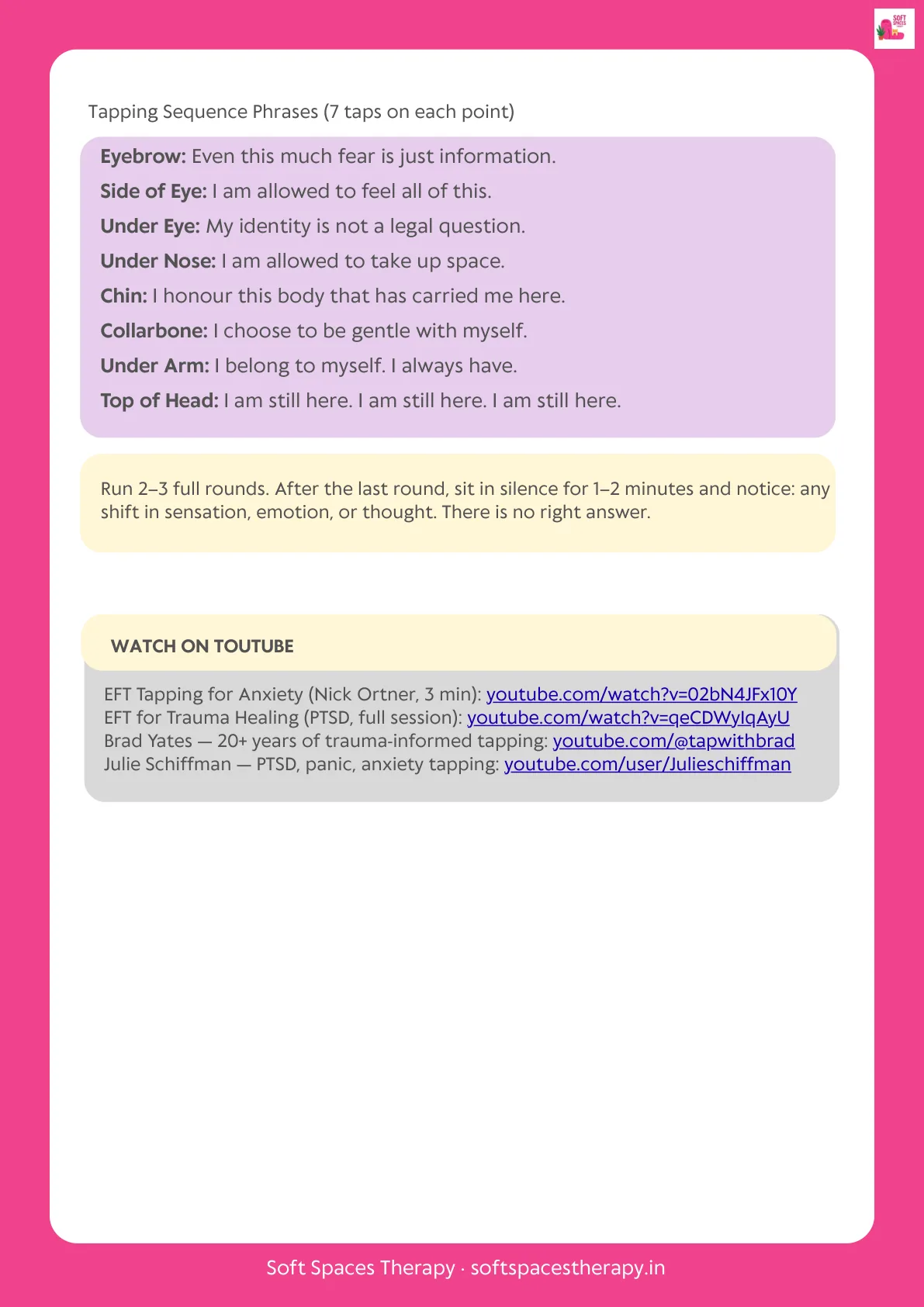
Tapping Sequence Phrases (7 taps on each point)
Run 2–3 full rounds. After the last round, sit in silence for 1–2 minutes and notice: any
shift in sensation, emotion, or thought. There is no right answer.
Soft Spaces Therapy · softspacestherapy.in
EFT Tapping for Anxiety (Nick Ortner, 3 min): youtube.com/watch?v=02bN4JFx10Y
EFT for Trauma Healing (PTSD, full session): youtube.com/watch?v=qeCDWyIqAyU
Brad Yates — 20+ years of trauma-informed tapping: youtube.com/@tapwithbrad
Julie Schiffman — PTSD, panic, anxiety tapping: youtube.com/user/Julieschiffman
Eyebrow: Even this much fear is just information.
Side of Eye: I am allowed to feel all of this.
Under Eye: My identity is not a legal question.
Under Nose: I am allowed to take up space.
Chin: I honour this body that has carried me here.
Collarbone: I choose to be gentle with myself.
Under Arm: I belong to myself. I always have.
Top of Head: I am still here. I am still here. I am still here.
WATCH ON TOUTUBE
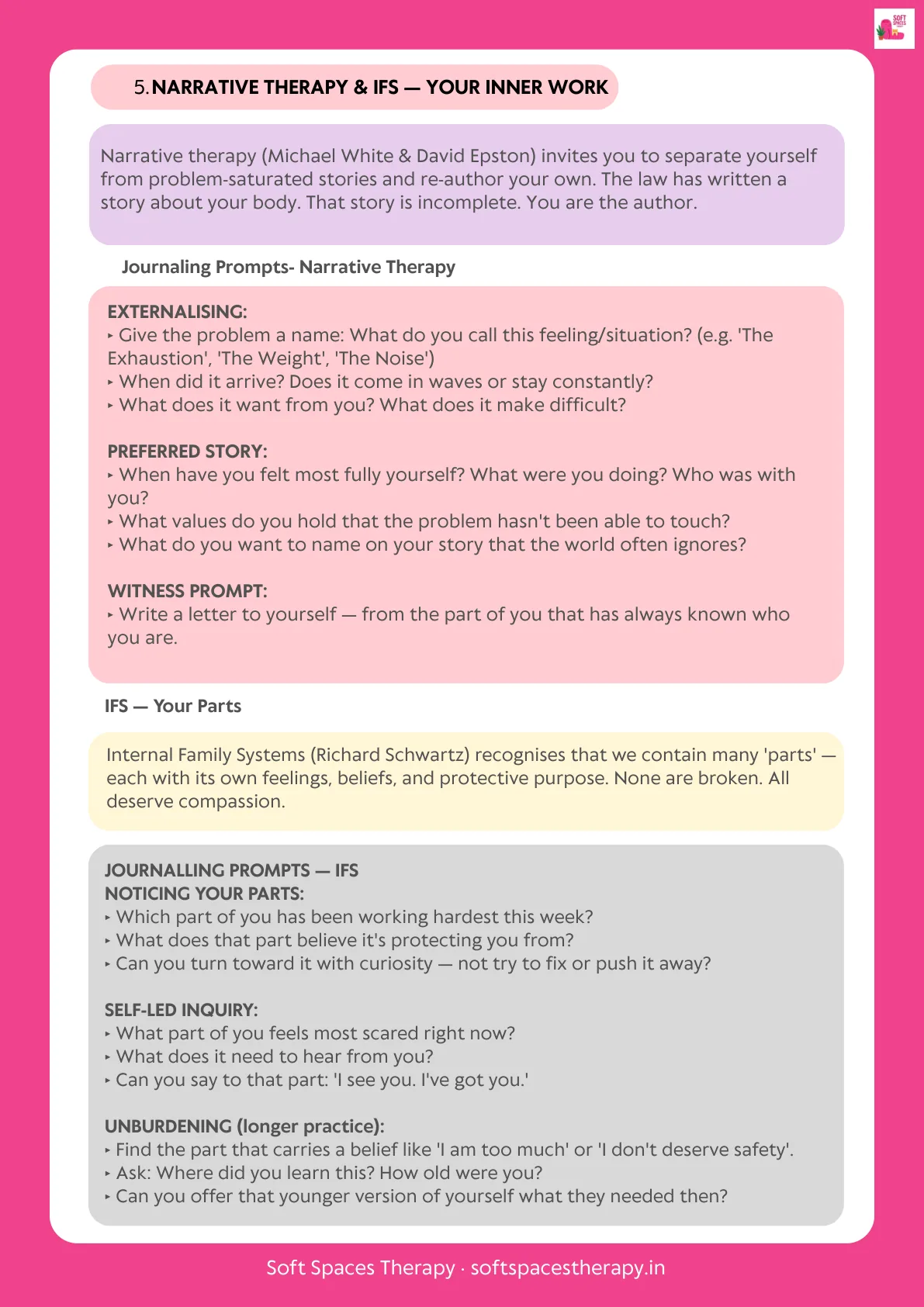
5.NARRATIVE THERAPY & IFS — YOUR INNER WORK
Narrative therapy (Michael White & David Epston) invites you to separate yourself
from problem-saturated stories and re-author your own. The law has written a
story about your body. That story is incomplete. You are the author.
IFS — Your Parts
Soft Spaces Therapy · softspacestherapy.in
Journaling Prompts- Narrative Therapy
JOURNALLING PROMPTS — IFS
NOTICING YOUR PARTS:
▸ Which part of you has been working hardest this week?
▸ What does that part believe it's protecting you from?
▸ Can you turn toward it with curiosity — not try to fix or push it away?
SELF-LED INQUIRY:
▸ What part of you feels most scared right now?
▸ What does it need to hear from you?
▸ Can you say to that part: 'I see you. I've got you.'
UNBURDENING (longer practice):
▸ Find the part that carries a belief like 'I am too much' or 'I don't deserve safety'.
▸ Ask: Where did you learn this? How old were you?
▸ Can you offer that younger version of yourself what they needed then?
EXTERNALISING:
▸ Give the problem a name: What do you call this feeling/situation? (e.g. 'The
Exhaustion', 'The Weight', 'The Noise')
▸ When did it arrive? Does it come in waves or stay constantly?
▸ What does it want from you? What does it make difficult?
PREFERRED STORY:
▸ When have you felt most fully yourself? What were you doing? Who was with
you?
▸ What values do you hold that the problem hasn't been able to touch?
▸ What do you want to name on your story that the world often ignores?
WITNESS PROMPT:
▸ Write a letter to yourself — from the part of you that has always known who
you are.
Internal Family Systems (Richard Schwartz) recognises that we contain many 'parts' —
each with its own feelings, beliefs, and protective purpose. None are broken. All
deserve compassion.
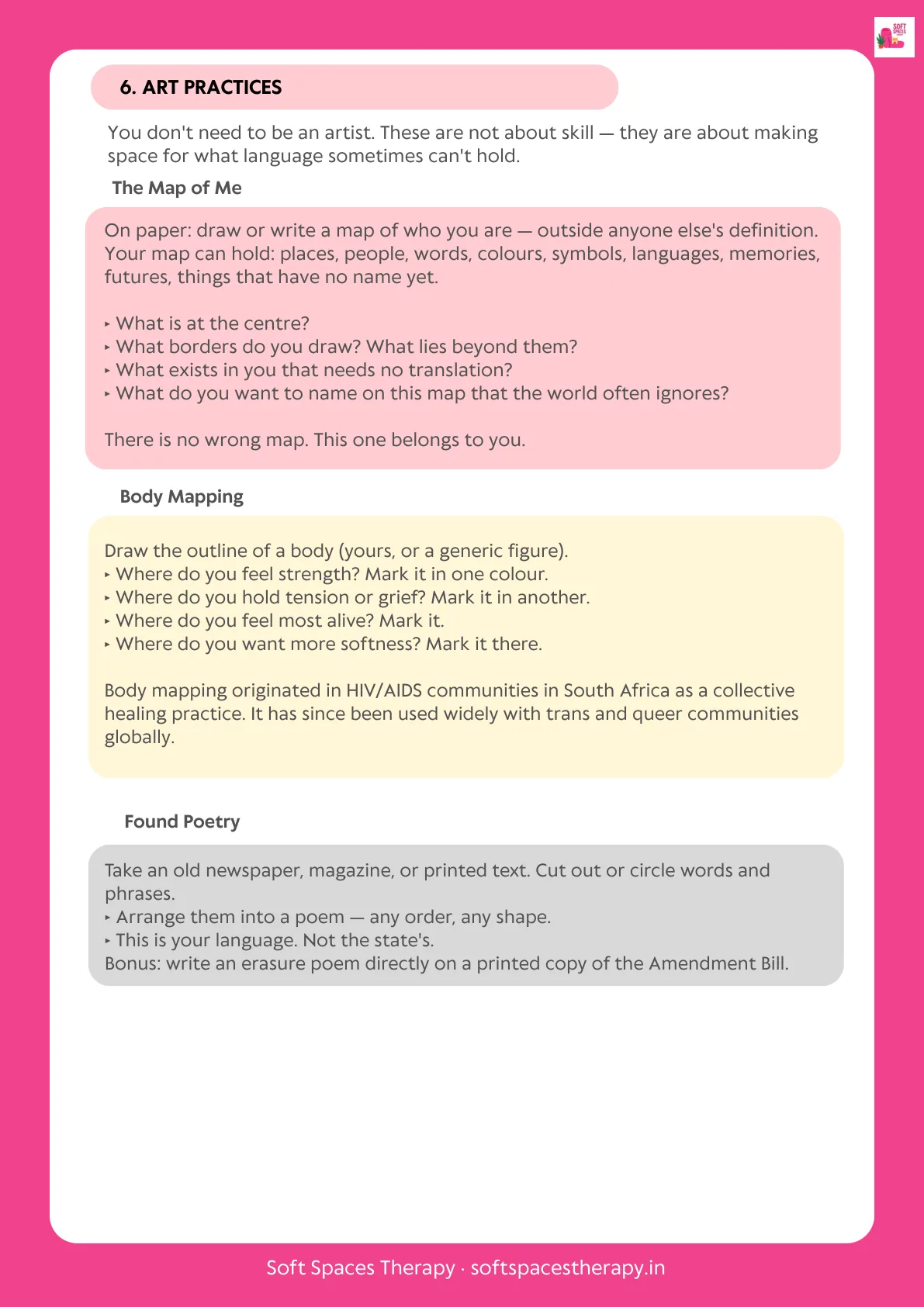
6. ART PRACTICES
You don't need to be an artist. These are not about skill — they are about making
space for what language sometimes can't hold.
Body Mapping
Soft Spaces Therapy · softspacestherapy.in
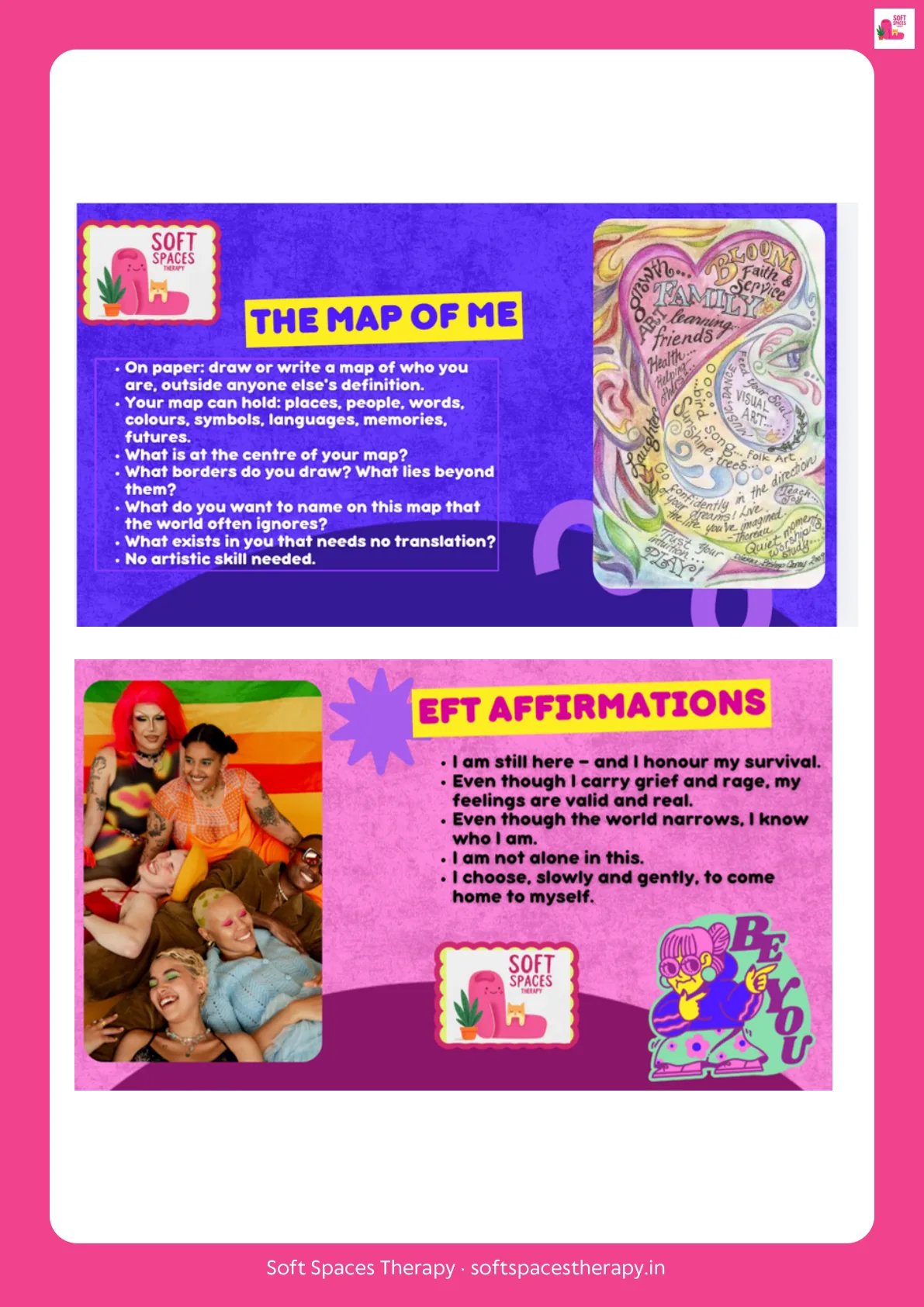
The Map of Me
Take an old newspaper, magazine, or printed text. Cut out or circle words and
phrases.
▸ Arrange them into a poem — any order, any shape.
▸ This is your language. Not the state's.
Bonus: write an erasure poem directly on a printed copy of the Amendment Bill.
On paper: draw or write a map of who you are — outside anyone else's definition.
Your map can hold: places, people, words, colours, symbols, languages, memories,
futures, things that have no name yet.
▸ What is at the centre?
▸ What borders do you draw? What lies beyond them?
▸ What exists in you that needs no translation?
▸ What do you want to name on this map that the world often ignores?
There is no wrong map. This one belongs to you.
Draw the outline of a body (yours, or a generic figure).
▸ Where do you feel strength? Mark it in one colour.
▸ Where do you hold tension or grief? Mark it in another.
▸ Where do you feel most alive? Mark it.
▸ Where do you want more softness? Mark it there.
Body mapping originated in HIV/AIDS communities in South Africa as a collective
healing practice. It has since been used widely with trans and queer communities
globally.
Found Poetry
Soft Spaces Therapy · softspacestherapy.in
Soft Spaces Therapy · softspacestherapy.in
7.WHEN EVERYTHING FEELS LIKE TOO MUCH
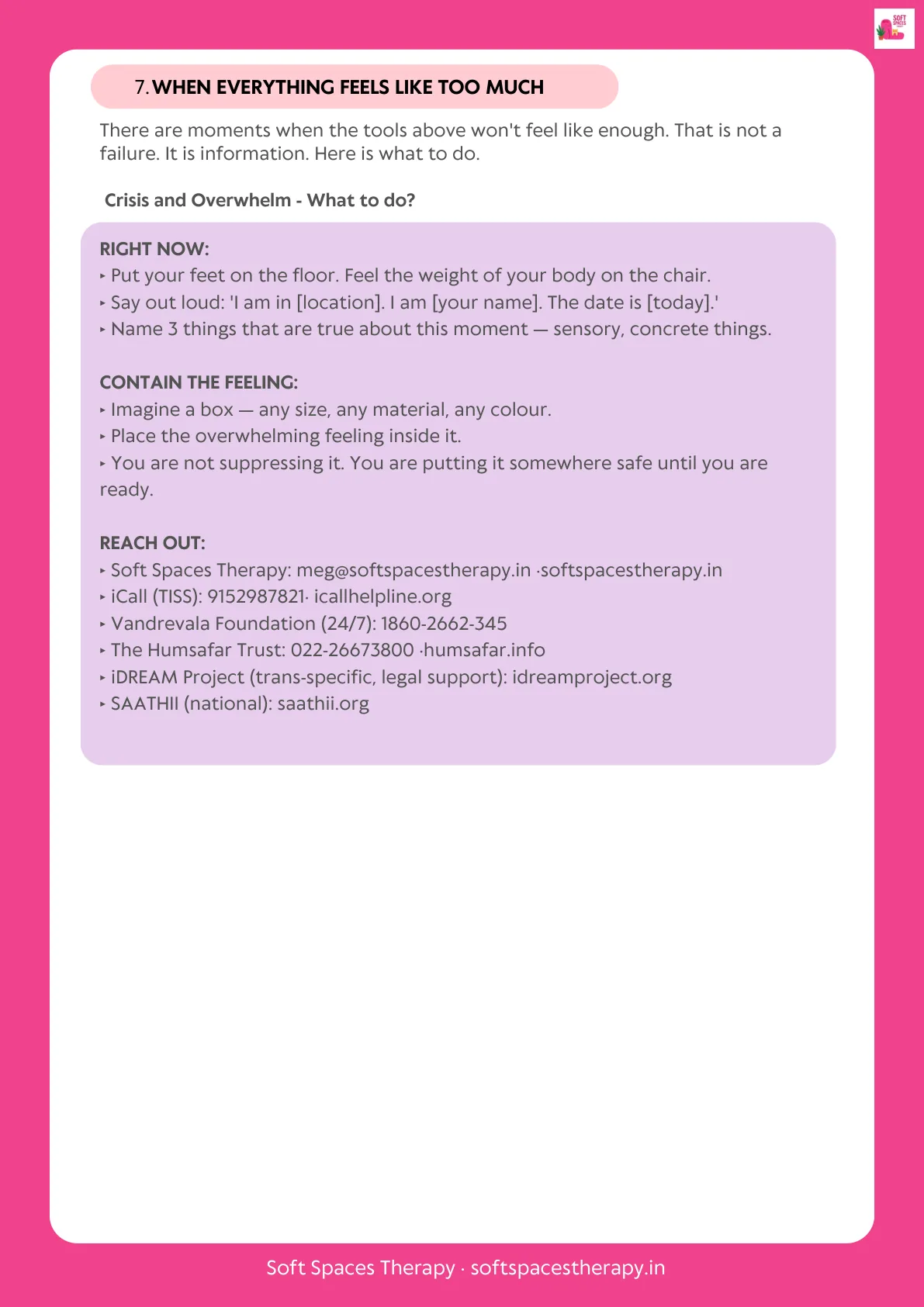
There are moments when the tools above won't feel like enough. That is not a
failure. It is information. Here is what to do.
Soft Spaces Therapy · softspacestherapy.in
Crisis and Overwhelm - What to do?
RIGHT NOW:
▸ Put your feet on the floor. Feel the weight of your body on the chair.
▸ Say out loud: 'I am in [location]. I am [your name]. The date is [today].'
▸ Name 3 things that are true about this moment — sensory, concrete things.
CONTAIN THE FEELING:
▸ Imagine a box — any size, any material, any colour.
▸ Place the overwhelming feeling inside it.
▸ You are not suppressing it. You are putting it somewhere safe until you are
ready.
REACH OUT:
▸ Soft Spaces Therapy: meg@softspacestherapy.in ·softspacestherapy.in
▸ iCall (TISS): 9152987821· icallhelpline.org
▸ Vandrevala Foundation (24/7): 1860-2662-345
▸ The Humsafar Trust: 022-26673800 ·humsafar.info
▸ iDREAM Project (trans-specific, legal support): idreamproject.org
▸ SAATHII (national): saathii.org
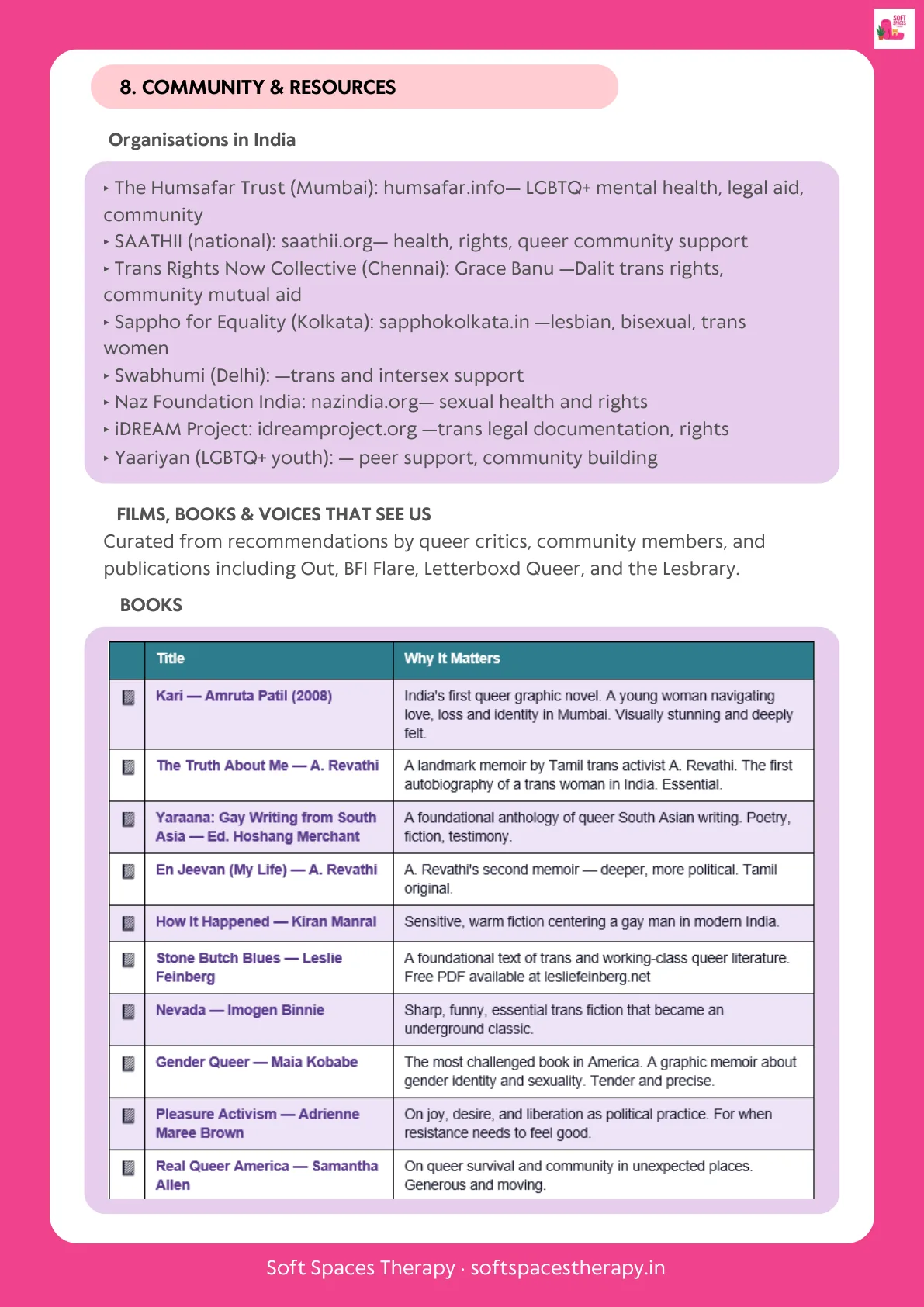
Organisations in India
8. COMMUNITY & RESOURCES
Soft Spaces Therapy · softspacestherapy.in
▸ The Humsafar Trust (Mumbai): humsafar.info— LGBTQ+ mental health, legal aid,
community
▸ SAATHII (national): saathii.org— health, rights, queer community support
▸ Trans Rights Now Collective (Chennai): Grace Banu —Dalit trans rights,
community mutual aid
▸ Sappho for Equality (Kolkata): sapphokolkata.in —lesbian, bisexual, trans
women
▸ Swabhumi (Delhi): —trans and intersex support
▸ Naz Foundation India: nazindia.org— sexual health and rights
▸ iDREAM Project: idreamproject.org —trans legal documentation, rights
▸ Yaariyan (LGBTQ+ youth): — peer support, community building
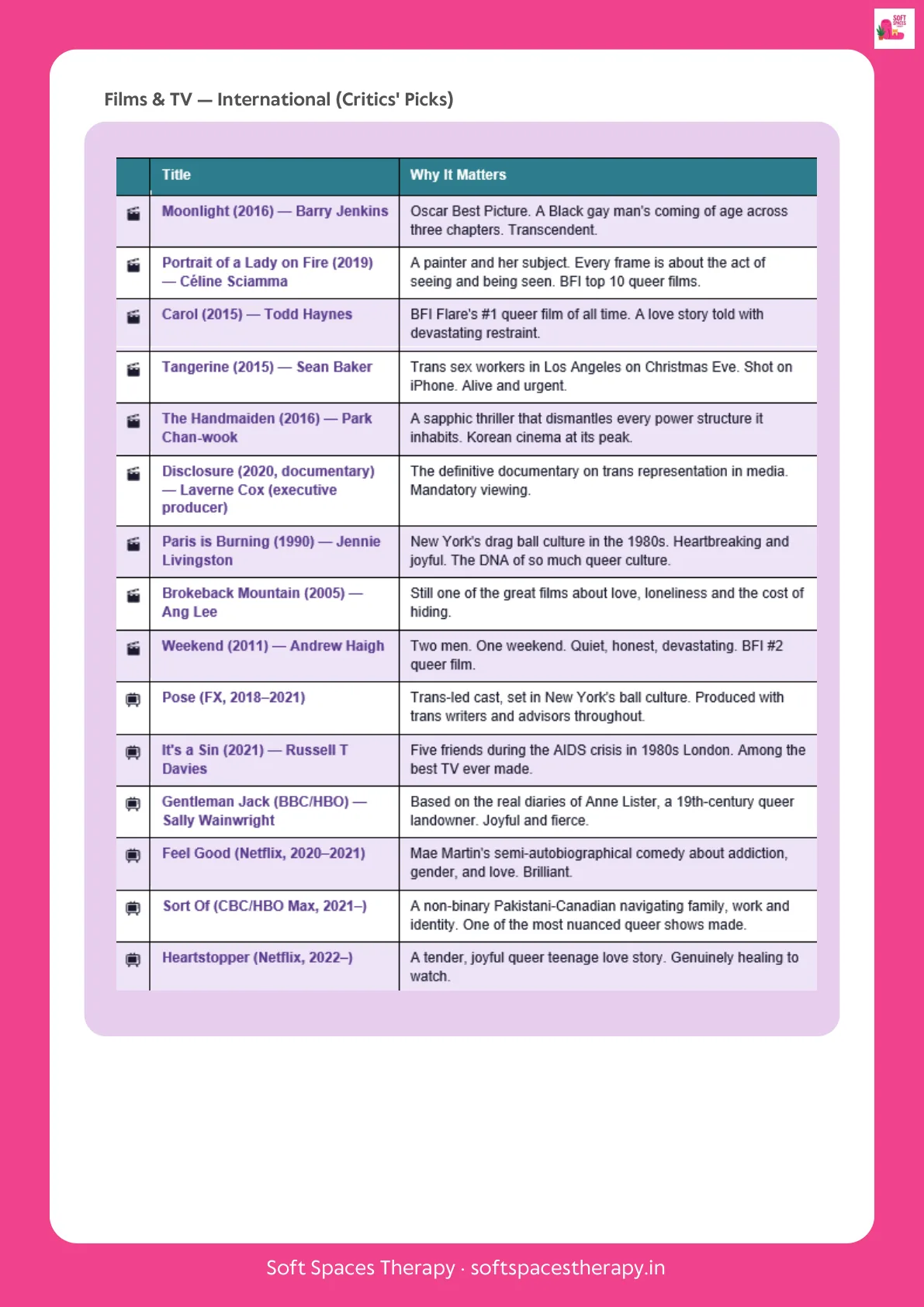
FILMS, BOOKS & VOICES THAT SEE US
Curated from recommendations by queer critics, community members, and
publications including Out, BFI Flare, Letterboxd Queer, and the Lesbrary.
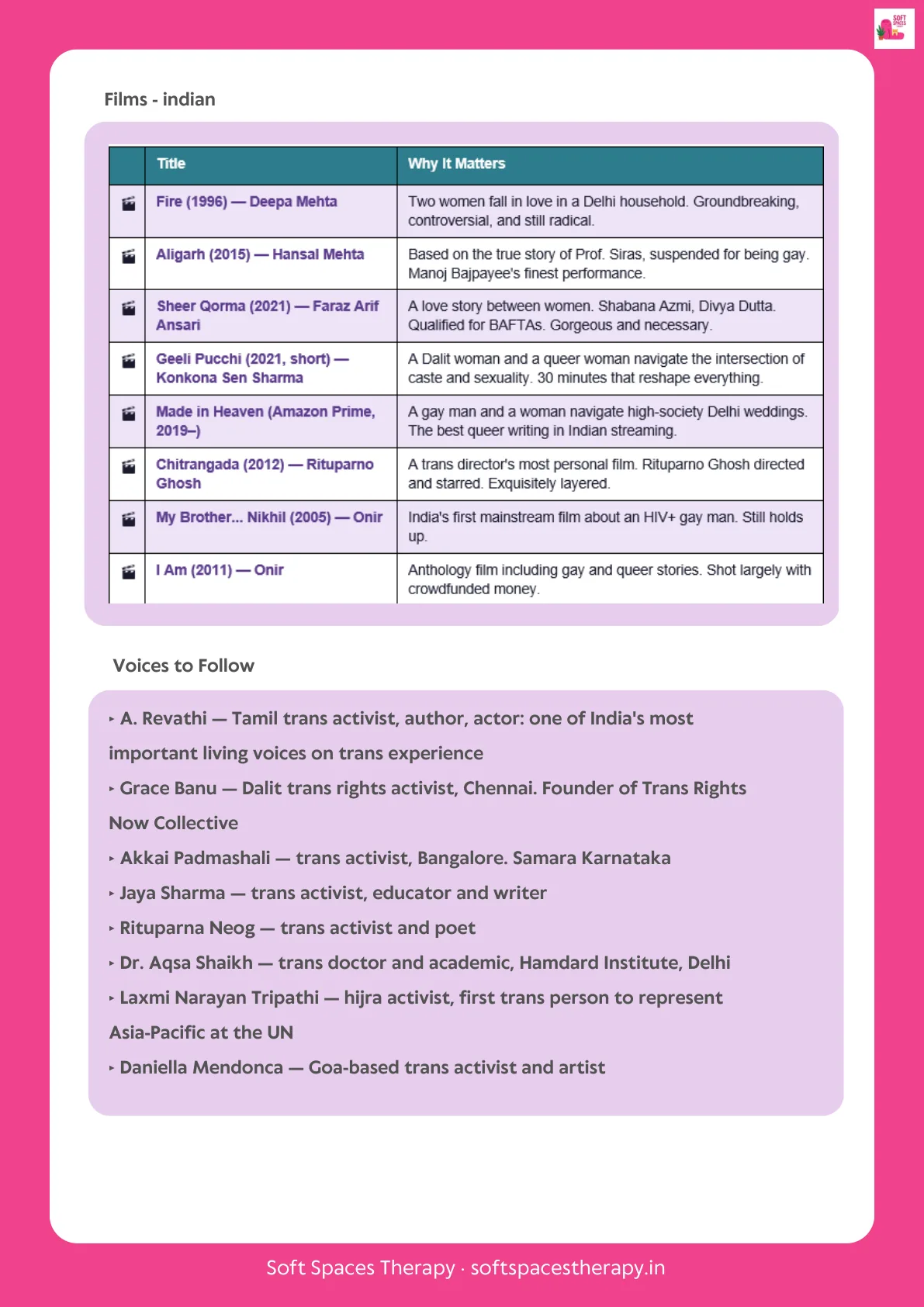
BOOKS
Soft Spaces Therapy · softspacestherapy.in
Films - indian
Voices to Follow
▸ A. Revathi — Tamil trans activist, author, actor: one of India's most
important living voices on trans experience
▸ Grace Banu — Dalit trans rights activist, Chennai. Founder of Trans Rights
Now Collective
▸ Akkai Padmashali — trans activist, Bangalore. Samara Karnataka
▸ Jaya Sharma — trans activist, educator and writer
▸ Rituparna Neog — trans activist and poet
▸ Dr. Aqsa Shaikh — trans doctor and academic, Hamdard Institute, Delhi
▸ Laxmi Narayan Tripathi — hijra activist, first trans person to represent
Asia-Pacific at the UN
▸ Daniella Mendonca — Goa-based trans activist and artist
Soft Spaces Therapy · softspacestherapy.in
Films & TV — International (Critics' Picks)
Soft Spaces Therapy · softspacestherapy.in
YOU SHOWED UP. THAT IS
ENOUGH. NOBODY CAN
WRITE OUT OUR EXISTENCE.
WE WILL ALWAYS BE HERE.
© 2026 Soft Spaces Therapy & Meghna Prakash
·meg@softspacestherapy.in · softspacestherapy.in
This resource is for personal use. Please do not reproduce
without permission.