
Care guide · free to read
At Our Own Pace
A tiny toolkit for autistic folks, by Jamila, Karina and Saima
A care guide grown out of our affinity support-group work — practical, gentle, and written to be used. Simple explanations, everyday autism-related words, and language you can borrow when the hardest part is finding the words.
18 pages · free to read, no sign-up
AT OUR OWN
PACE
AT OUR OWN
PACE
A Tiny Toolkit for Autistic folks
By your facilitators:
Jamila (she/her)
Karina (she/her)
Saima (she/her)
Soft Spaces Therapy · softspacestherapy.in
About this toolkit
Consider this as a side quest for self-understanding,
self-advocacy, and self-compassion.
Inside, you'll find simple explanations, everyday
autism-related words, practical self-advocacy tips,
and grounding tools you can return to whenever
things feel confusing, overwhelming, or just a
little too much. Whether you've just left a therapy
session, are preparing for a difficult conversation,
or simply need a moment to reconnect with
yourself, this toolkit is here to meet you where
you are.
There is no right way to use it, only the way that
feels most supportive for you. Use what feels
helpful. Leave what doesn't. Your experiences are
your own, and not every tool will fit every person
or every day.
Made for neurodivergents, by neurodivergents...To save
you from the rabbit hole internet is when it comes to
autism self-explorations.
Soft Spaces Therapy · softspacestherapy.in
Before we begin..
there's something we'd love for you to know.
There is nothing wrong with your brain.
Autistic brains aren't broken, disordered, or less than,
they're different. They experience, process, and respond to
the world in their own ways. That's part of the beautiful
diversity of being human.
At the same time, we know the world isn't always built with
autistic people in mind. Bright lights, noisy spaces, unclear
expectations, constant social demands, inaccessible
environments, and pressure to "fit in" can all take a toll.
Sometimes, it's not you that's struggling, it's the mismatch
between your needs and the world around you.
We also believe that you are the expert on your own
experience. This toolkit isn't here to tell you who you are.
Instead, it's here to offer words, ideas, and tools that you
can take, leave, adapt, or come back to whenever they feel
helpful.
If something doesn't resonate, that's okay.
If something helps, keep it.
If your experience looks different, we believe you.
This toolkit is simply here to walk alongside you,
at your own pace.
Soft Spaces Therapy · softspacestherapy.in
WHEN THINGS FEEL WOBBLY
Have you ever felt like everything suddenly becomes too loud, too bright,
too busy, or simply too much?
That's often a sign that your nervous system is working very hard.
Your nervous system is like your body's built-in safety system. Its job is
to notice what's happening around you and help you respond. When it
feels safe, it helps you think clearly, connect with others, and do the
things that matter to you.
But when your brain and body have been dealing with too much for too
long, your nervous system can become dysregulated.
These responses aren't signs that you've failed. They're your body's way of
saying, "I've been carrying a lot."
The good news is that nervous systems can be supported.
Small moments of rest, movement, sensory comfort, connection,
stimming, predictable routines, and self-compassion can all help your brain
and body find their way back to a place that feels safer.
That's where this toolkit comes in.
Not because you need fixing.
But because everyone deserves support.
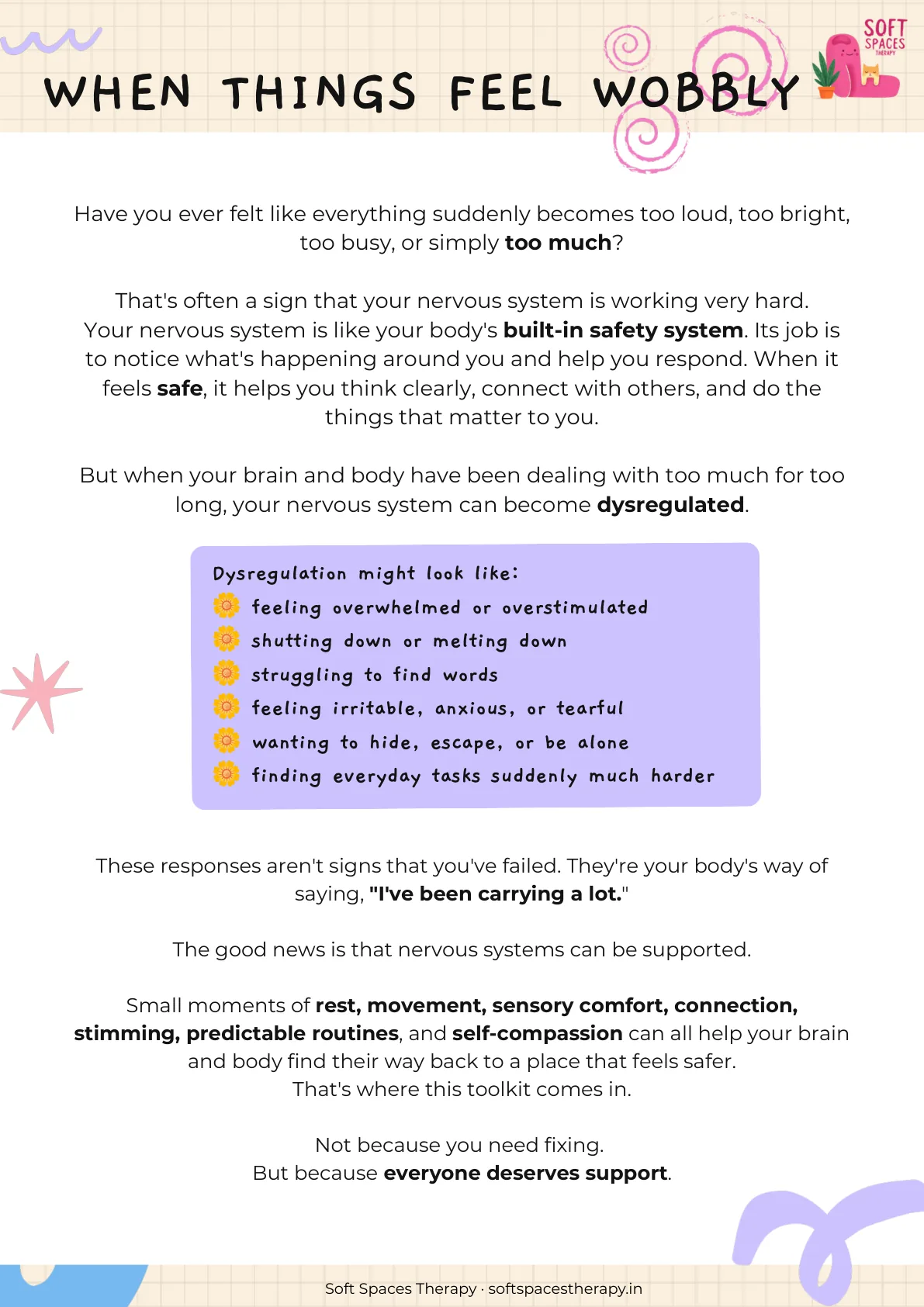
Dysregulation might look like:
🌼 feeling overwhelmed or overstimulated
🌼 shutting down or melting down
🌼 struggling to find words
🌼 feeling irritable, anxious, or tearful
🌼 wanting to hide, escape, or be alone
🌼 finding everyday tasks suddenly much harder
Soft Spaces Therapy · softspacestherapy.in
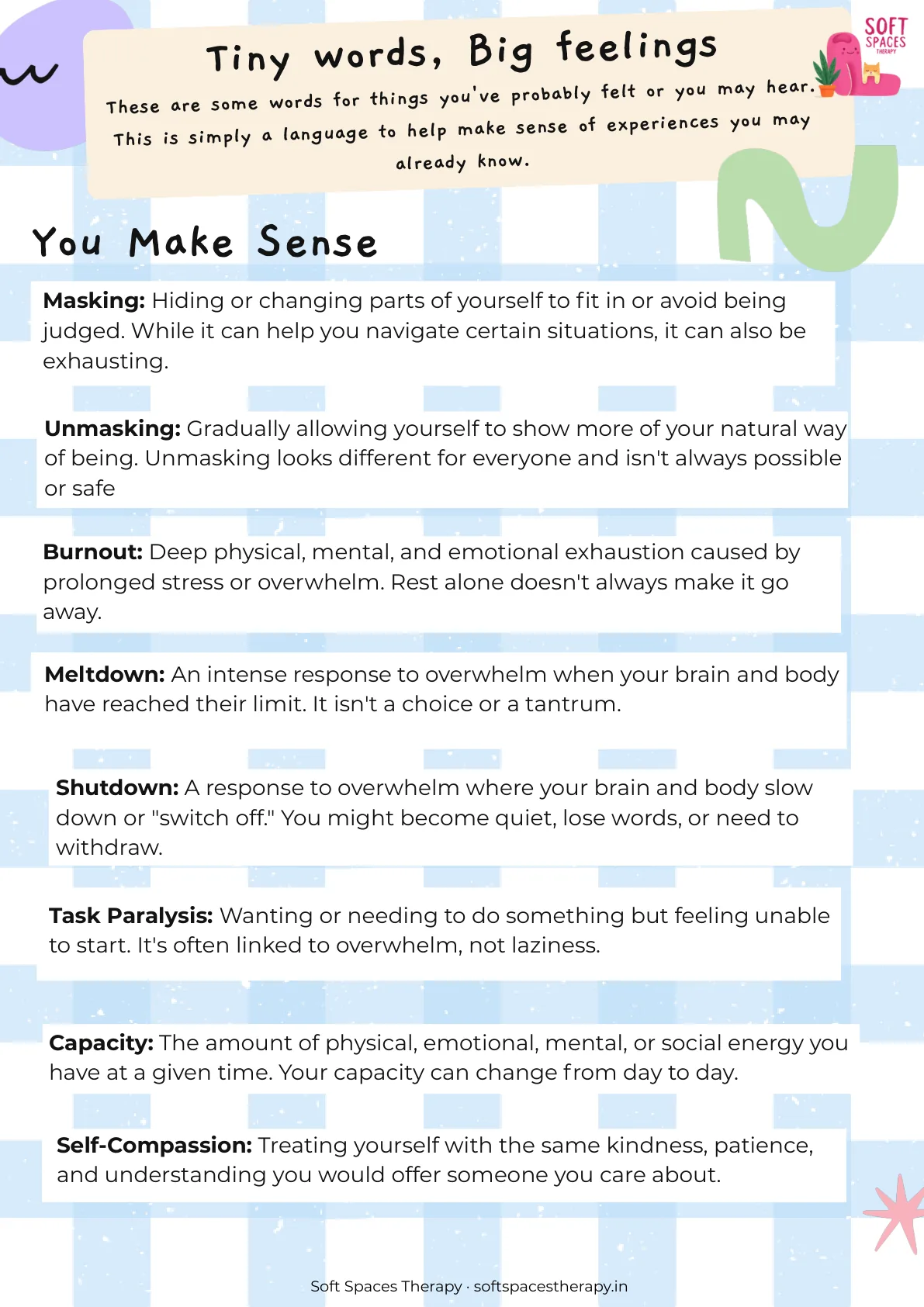
Tiny words, Big feelings
These are some words for things you've probably felt or you may hear.
This is simply a language to help make sense of experiences you may
already know.
You Make Sense
Masking: Hiding or changing parts of yourself to fit in or avoid being
judged. While it can help you navigate certain situations, it can also be
exhausting.
Unmasking: Gradually allowing yourself to show more of your natural way
of being. Unmasking looks different for everyone and isn't always possible
or safe
Burnout: Deep physical, mental, and emotional exhaustion caused by
prolonged stress or overwhelm. Rest alone doesn't always make it go
away.
Meltdown: An intense response to overwhelm when your brain and body
have reached their limit. It isn't a choice or a tantrum.
Shutdown: A response to overwhelm where your brain and body slow
down or "switch off." You might become quiet, lose words, or need to
withdraw.
Task Paralysis: Wanting or needing to do something but feeling unable
to start. It's often linked to overwhelm, not laziness.
Capacity: The amount of physical, emotional, mental, or social energy you
have at a given time. Your capacity can change from day to day.
Self-Compassion: Treating yourself with the same kindness, patience,
and understanding you would offer someone you care about.
Soft Spaces Therapy · softspacestherapy.in
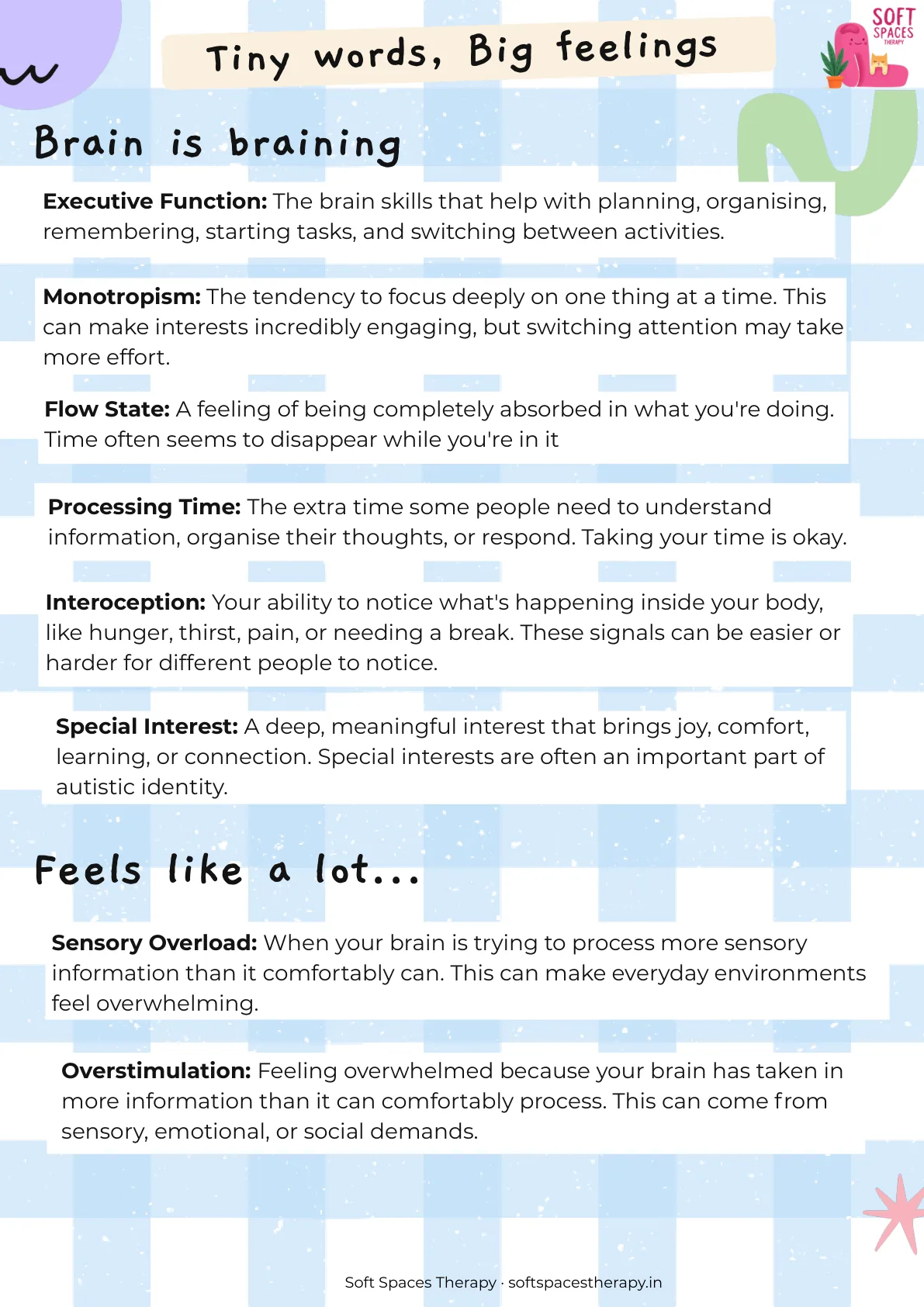
Tiny words, Big feelings
Brain is braining
Executive Function: The brain skills that help with planning, organising,
remembering, starting tasks, and switching between activities.
Monotropism: The tendency to focus deeply on one thing at a time. This
can make interests incredibly engaging, but switching attention may take
more effort.
Flow State: A feeling of being completely absorbed in what you're doing.
Time often seems to disappear while you're in it
Interoception: Your ability to notice what's happening inside your body,
like hunger, thirst, pain, or needing a break. These signals can be easier or
harder for different people to notice.
Special Interest: A deep, meaningful interest that brings joy, comfort,
learning, or connection. Special interests are often an important part of
autistic identity.
Feels like a lot...
Processing Time: The extra time some people need to understand
information, organise their thoughts, or respond. Taking your time is okay.
Sensory Overload: When your brain is trying to process more sensory
information than it comfortably can. This can make everyday environments
feel overwhelming.
Overstimulation: Feeling overwhelmed because your brain has taken in
more information than it can comfortably process. This can come from
sensory, emotional, or social demands.
Soft Spaces Therapy · softspacestherapy.in
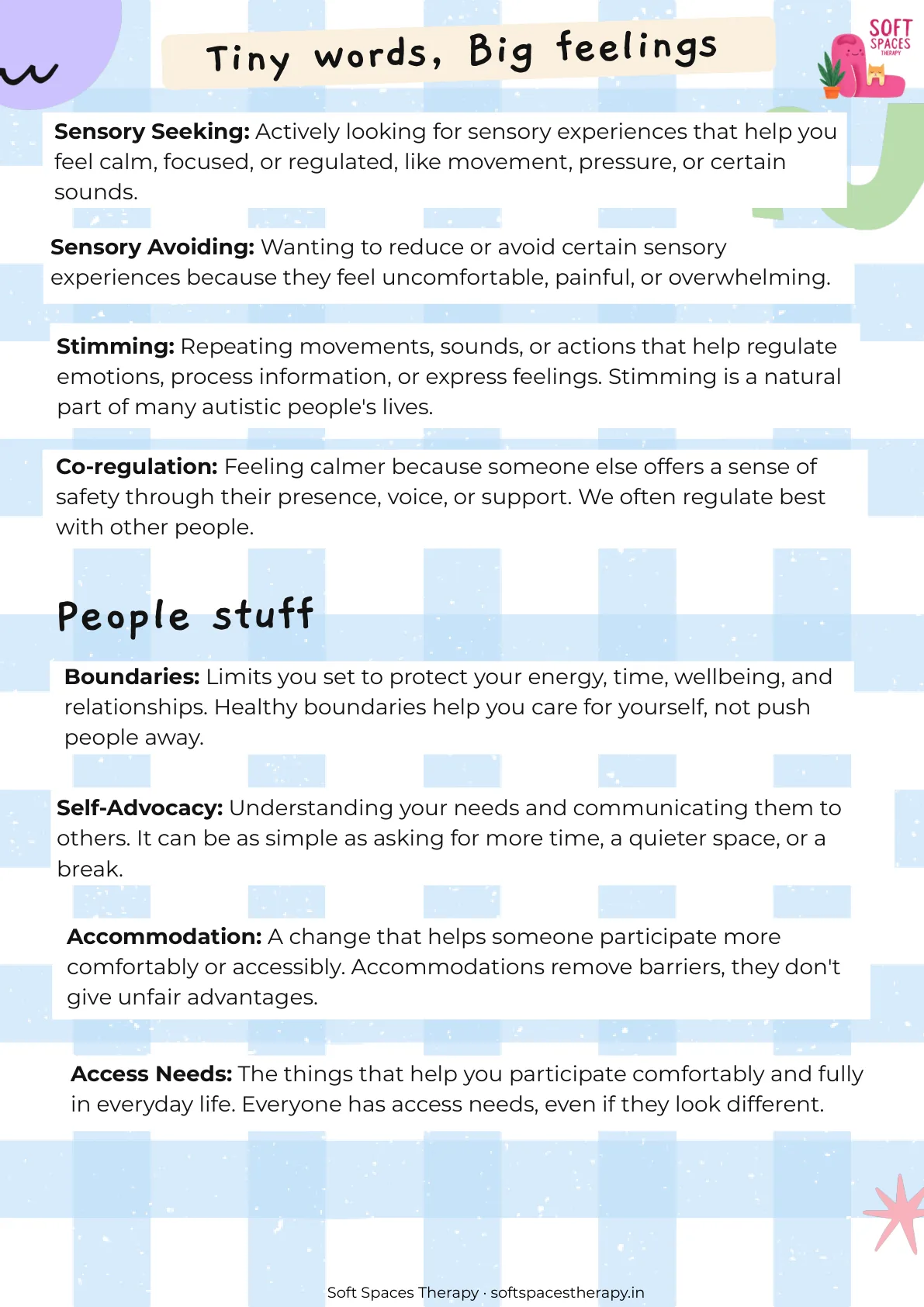
Tiny words, Big feelings
Sensory Seeking: Actively looking for sensory experiences that help you
feel calm, focused, or regulated, like movement, pressure, or certain
sounds.
Sensory Avoiding: Wanting to reduce or avoid certain sensory
experiences because they feel uncomfortable, painful, or overwhelming.
Boundaries: Limits you set to protect your energy, time, wellbeing, and
relationships. Healthy boundaries help you care for yourself, not push
people away.
Co-regulation: Feeling calmer because someone else offers a sense of
safety through their presence, voice, or support. We often regulate best
with other people.
People stuff
Accommodation: A change that helps someone participate more
comfortably or accessibly. Accommodations remove barriers, they don't
give unfair advantages.
Self-Advocacy: Understanding your needs and communicating them to
others. It can be as simple as asking for more time, a quieter space, or a
break.
Stimming: Repeating movements, sounds, or actions that help regulate
emotions, process information, or express feelings. Stimming is a natural
part of many autistic people's lives.
Access Needs: The things that help you participate comfortably and fully
in everyday life. Everyone has access needs, even if they look different.
Soft Spaces Therapy · softspacestherapy.in
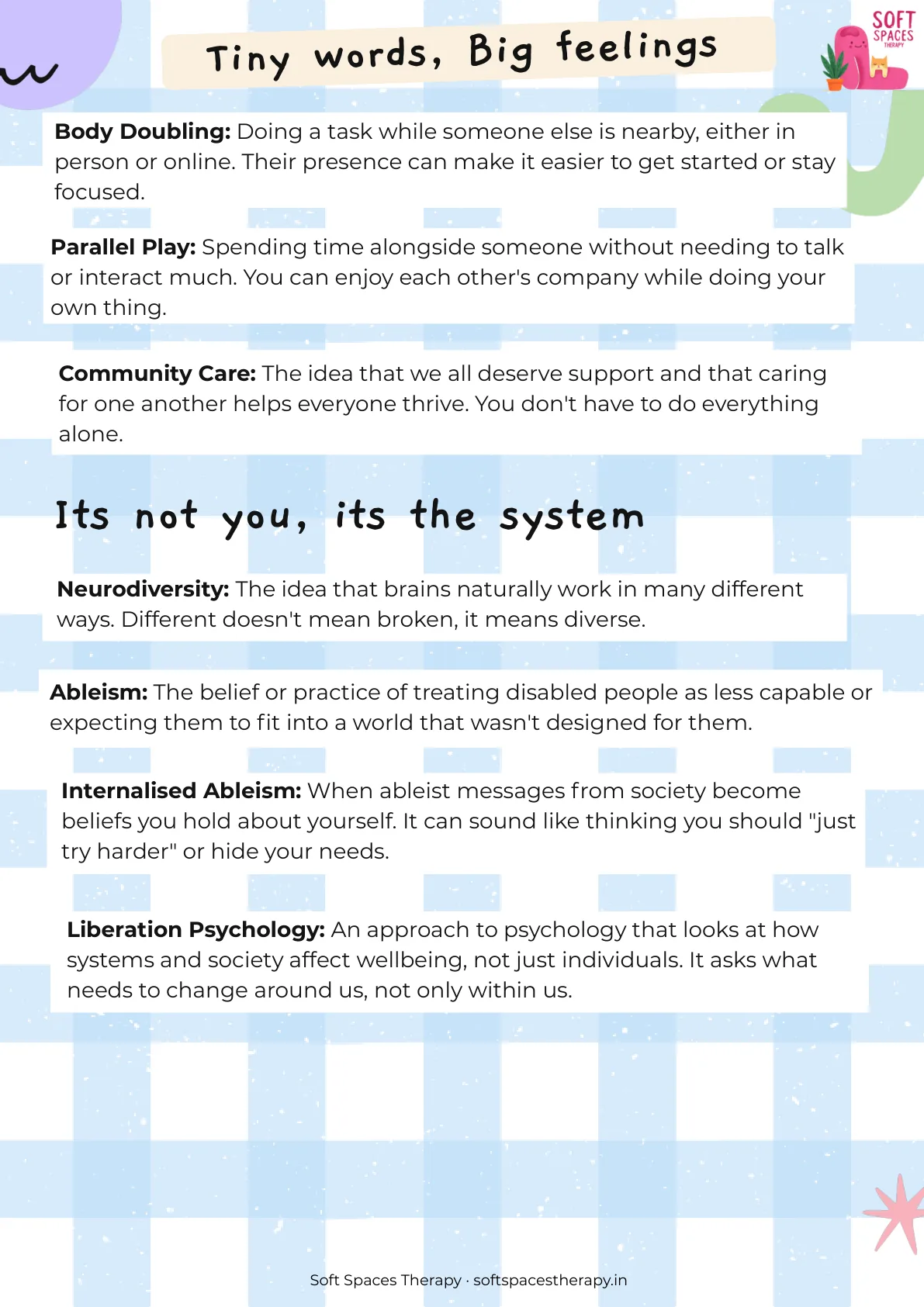
Tiny words, Big feelings
Body Doubling: Doing a task while someone else is nearby, either in
person or online. Their presence can make it easier to get started or stay
focused.
Parallel Play: Spending time alongside someone without needing to talk
or interact much. You can enjoy each other's company while doing your
own thing.
Its not you, its the system
Community Care: The idea that we all deserve support and that caring
for one another helps everyone thrive. You don't have to do everything
alone.
Neurodiversity: The idea that brains naturally work in many different
ways. Different doesn't mean broken, it means diverse.
Internalised Ableism: When ableist messages from society become
beliefs you hold about yourself. It can sound like thinking you should "just
try harder" or hide your needs.
Ableism: The belief or practice of treating disabled people as less capable or
expecting them to fit into a world that wasn't designed for them.
Liberation Psychology: An approach to psychology that looks at how
systems and society affect wellbeing, not just individuals. It asks what
needs to change around us, not only within us.
Soft Spaces Therapy · softspacestherapy.in
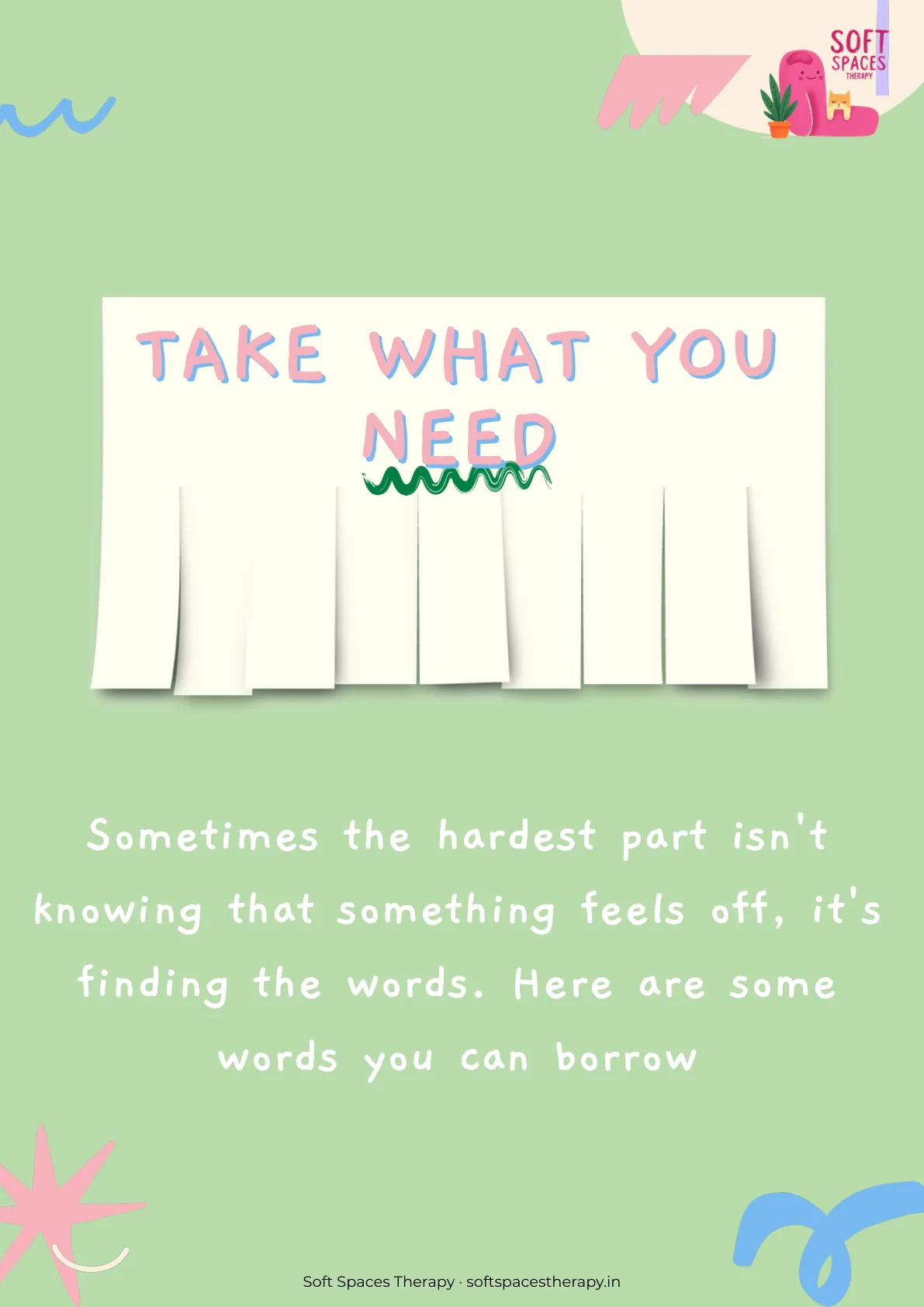
TAKE WHAT YOU
NEED
TAKE WHAT YOU
NEED
Sometimes the hardest part isn't
knowing that something feels off, it's
finding the words. Here are some
words you can borrow
Soft Spaces Therapy · softspacestherapy.in
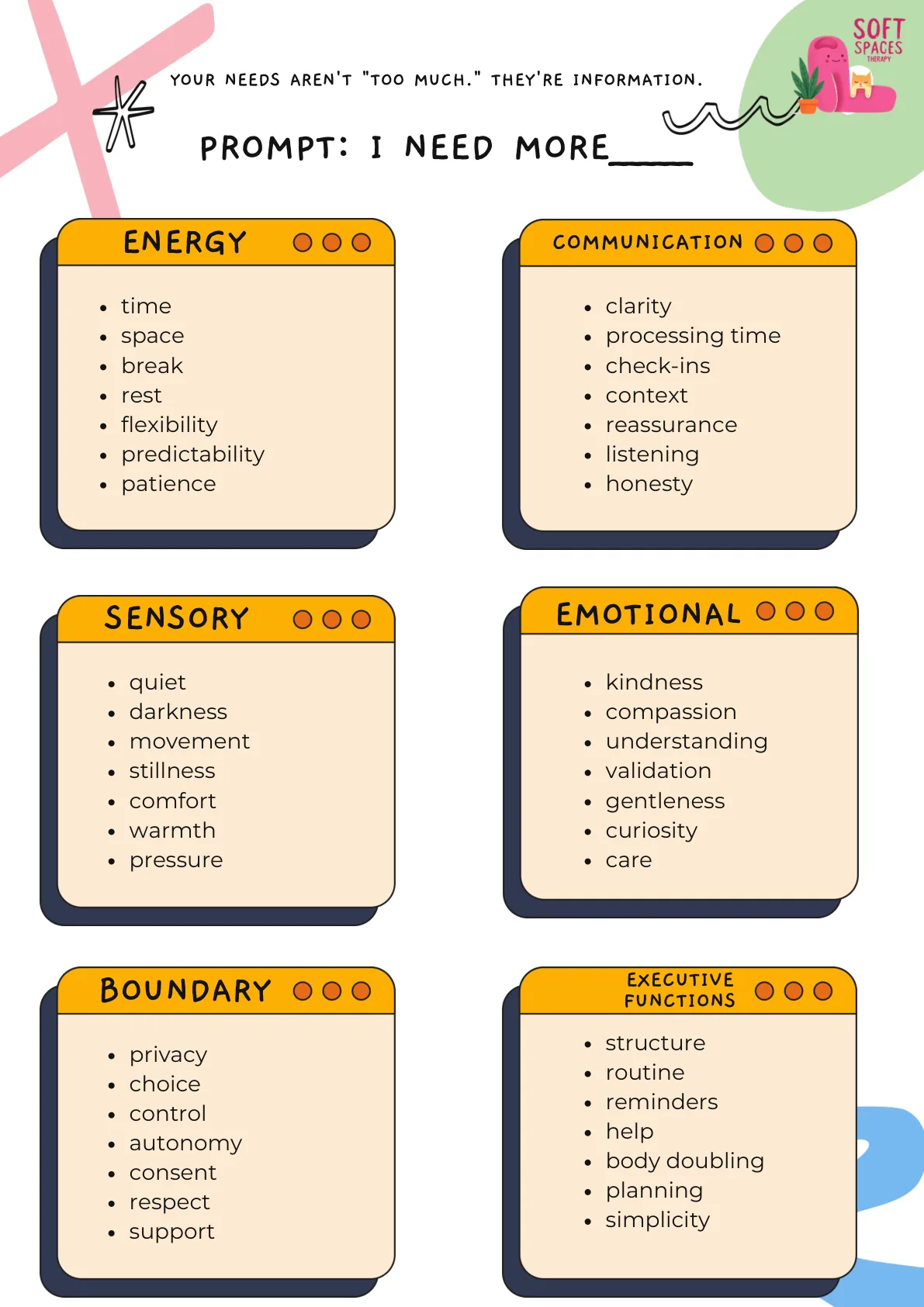
ENERGY
time
space
break
rest
flexibility
predictability
patience
PROMPT: I NEED MORE______
COMMUNICATION
clarity
processing time
check-ins
context
reassurance
listening
honesty
SENSORY
quiet
darkness
movement
stillness
comfort
warmth
pressure
EMOTIONAL
kindness
compassion
understanding
validation
gentleness
curiosity
care
BOUNDARY
privacy
choice
control
autonomy
consent
respect
support
EXECUTIVE
FUNCTIONS
structure
routine
reminders
help
body doubling
planning
simplicity
YOUR NEEDS AREN'T "TOO MUCH." THEY'RE INFORMATION.
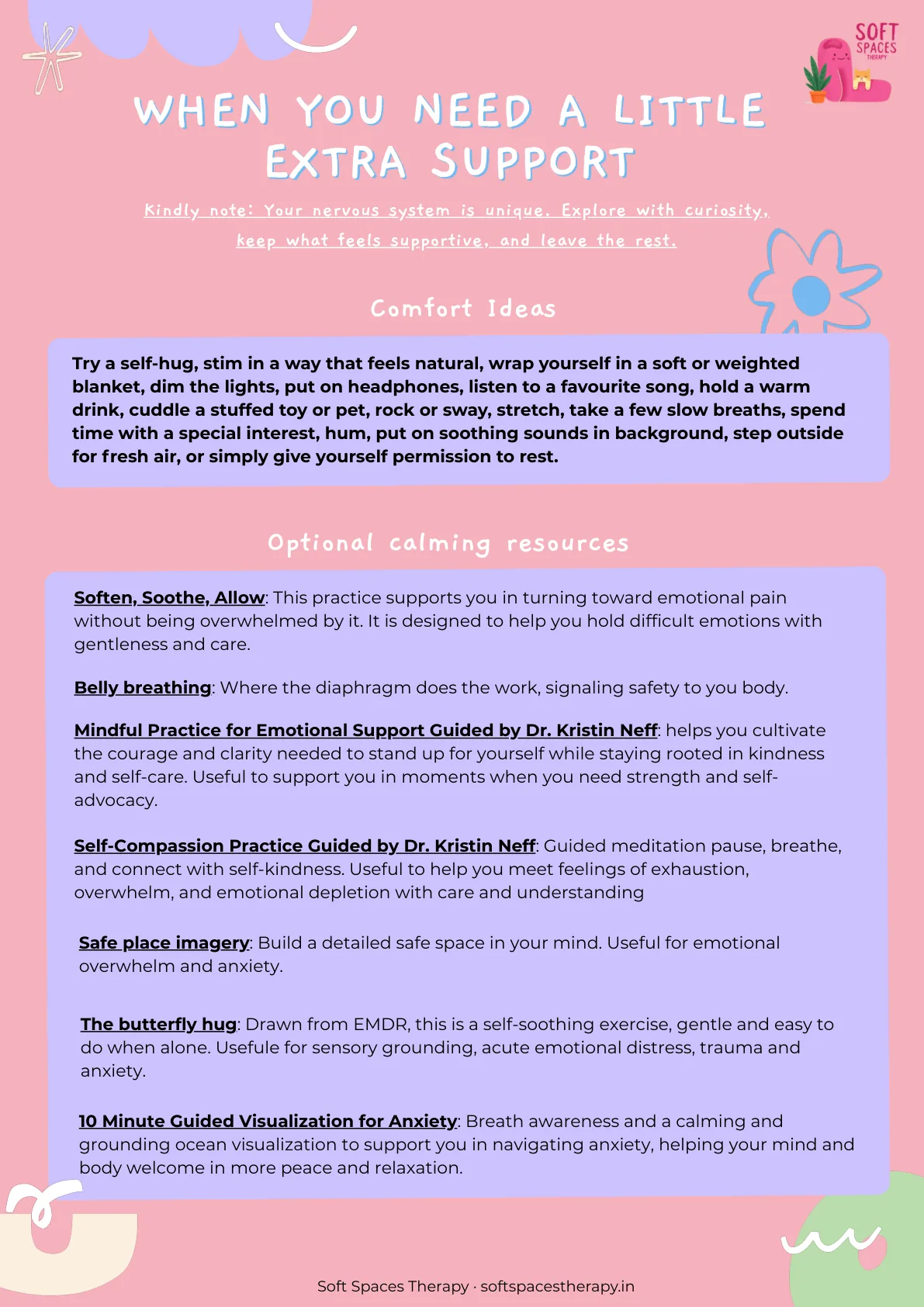
WHEN YOU NEED A LITTLE
EXTRA SUPPORT
WHEN YOU NEED A LITTLE
EXTRA SUPPORT
Optional calming resources
Self-Compassion Practice Guided by Dr. Kristin Neff: Guided meditation pause, breathe,
and connect with self-kindness. Useful to help you meet feelings of exhaustion,
overwhelm, and emotional depletion with care and understanding
The butterfly hug: Drawn from EMDR, this is a self-soothing exercise, gentle and easy to
do when alone. Usefule for sensory grounding, acute emotional distress, trauma and
anxiety.
Safe place imagery: Build a detailed safe space in your mind. Useful for emotional
overwhelm and anxiety.
10 Minute Guided Visualization for Anxiety: Breath awareness and a calming and
grounding ocean visualization to support you in navigating anxiety, helping your mind and
body welcome in more peace and relaxation.
Belly breathing: Where the diaphragm does the work, signaling safety to you body.
Mindful Practice for Emotional Support Guided by Dr. Kristin Neff: helps you cultivate
the courage and clarity needed to stand up for yourself while staying rooted in kindness
and self-care. Useful to support you in moments when you need strength and self-
advocacy.
Soften, Soothe, Allow: This practice supports you in turning toward emotional pain
without being overwhelmed by it. It is designed to help you hold difficult emotions with
gentleness and care.
Kindly note: Your nervous system is unique. Explore with curiosity,
keep what feels supportive, and leave the rest.
Try a self-hug, stim in a way that feels natural, wrap yourself in a soft or weighted
blanket, dim the lights, put on headphones, listen to a favourite song, hold a warm
drink, cuddle a stuffed toy or pet, rock or sway, stretch, take a few slow breaths, spend
time with a special interest, hum, put on soothing sounds in background, step outside
for fresh air, or simply give yourself permission to rest.
Comfort Ideas
Soft Spaces Therapy · softspacestherapy.in
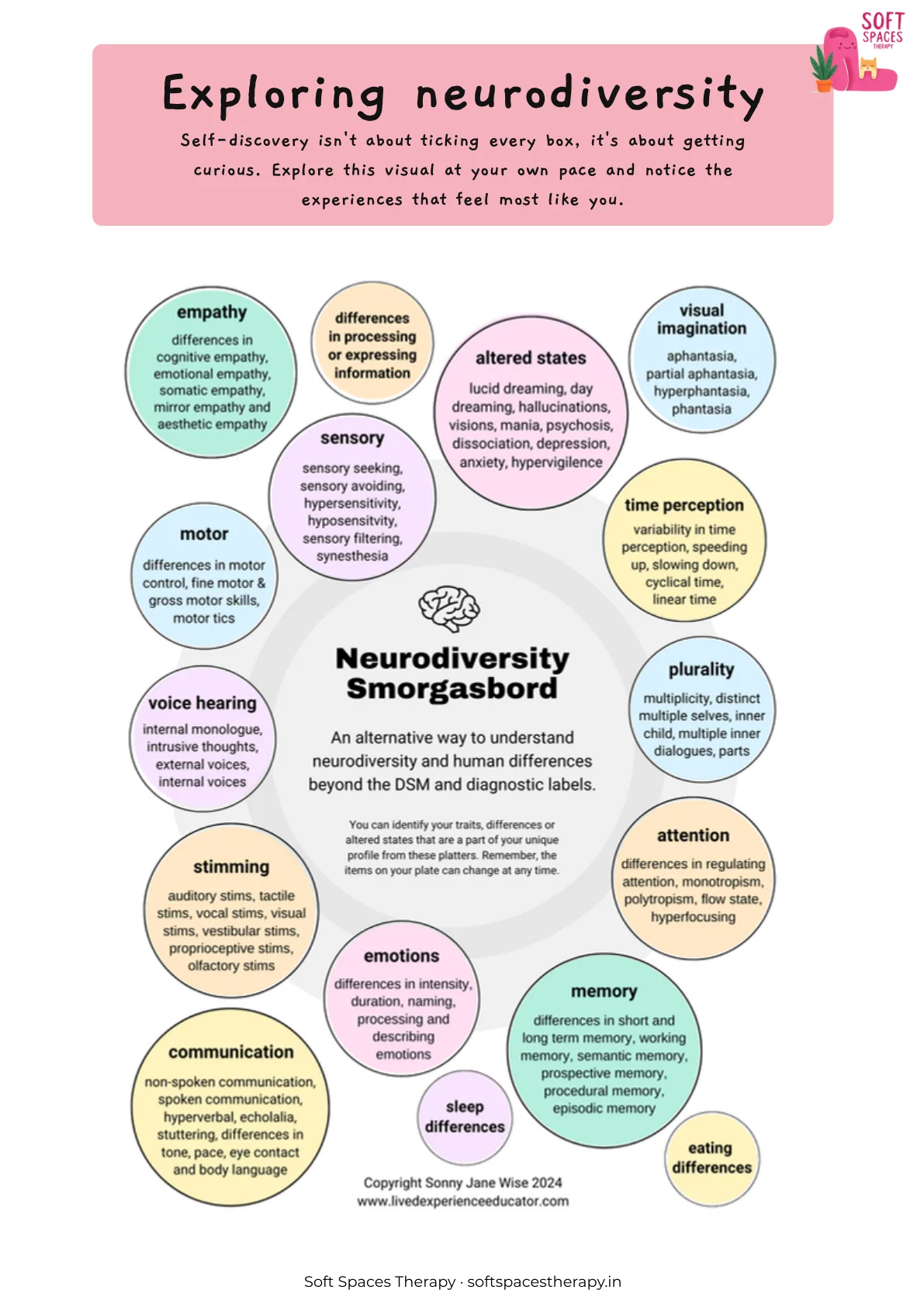
Exploring neurodiversity
Self-discovery isn't about ticking every box, it's about getting
curious. Explore this visual at your own pace and notice the
experiences that feel most like you.
Soft Spaces Therapy · softspacestherapy.in
In case you forgot...
Somewhere between a sticky note from a friend and a therapist gently
reminding you of things you already know.
Soft Spaces Therapy · softspacestherapy.in
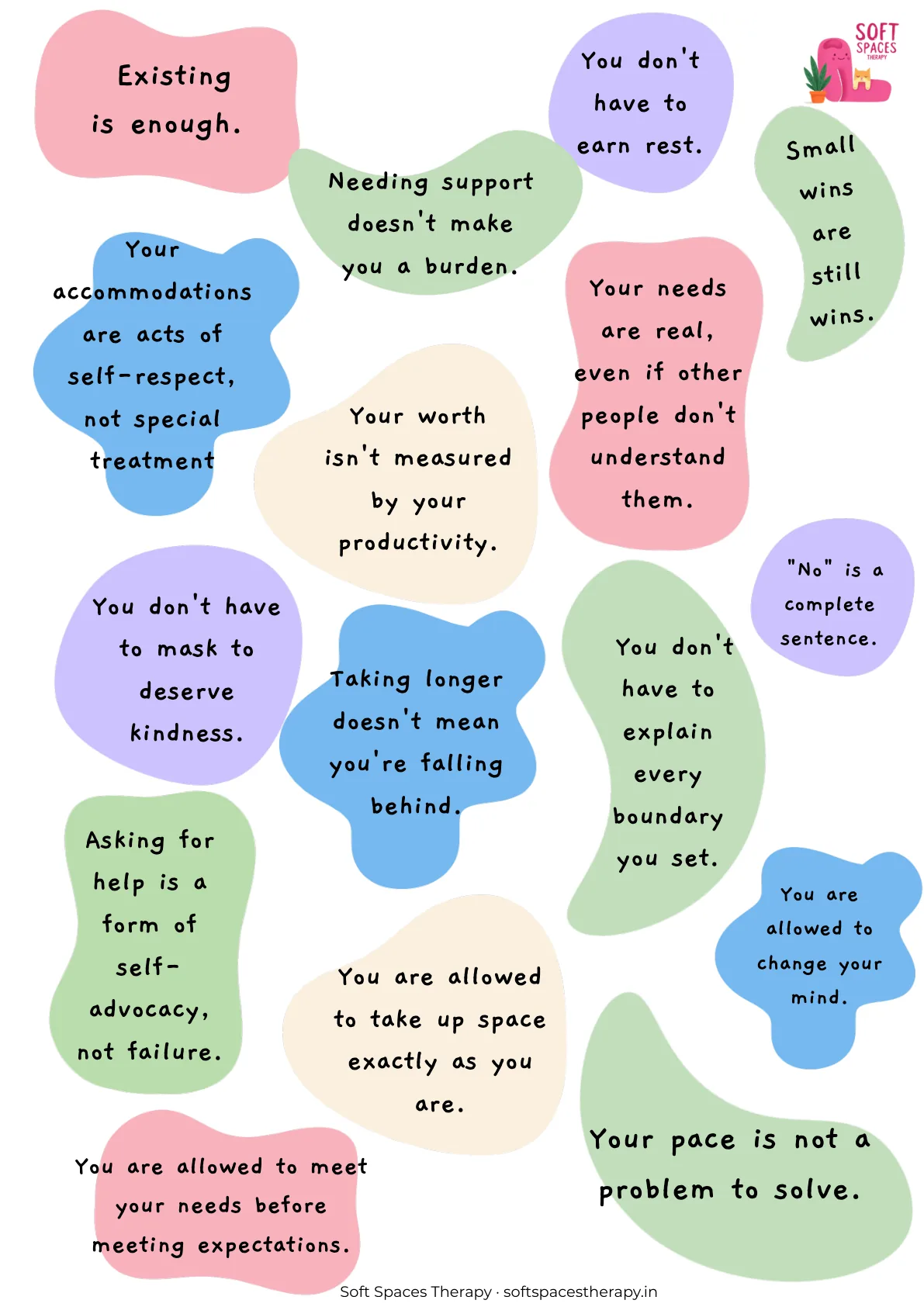
You don't
have to
earn rest.
Your needs
are real,
even if other
people don't
understand
them.
Needing support
doesn't make
you a burden.
You don't
have to
explain
every
boundary
you set.
"No" is a
complete
sentence.
Taking longer
doesn't mean
you're falling
behind.
Your worth
isn't measured
by your
productivity.
You don't have
to mask to
deserve
kindness.
You are allowed
to take up space
exactly as you
are.
Asking for
help is a
form of
self-
advocacy,
not failure.
You are
allowed to
change your
mind.
Small
wins
are
still
wins.
Existing
is enough.
Your
accommodations
are acts of
self-respect,
not special
treatment
You are allowed to meet
your needs before
meeting expectations.
Your pace is not a
problem to solve.
Soft Spaces Therapy · softspacestherapy.in
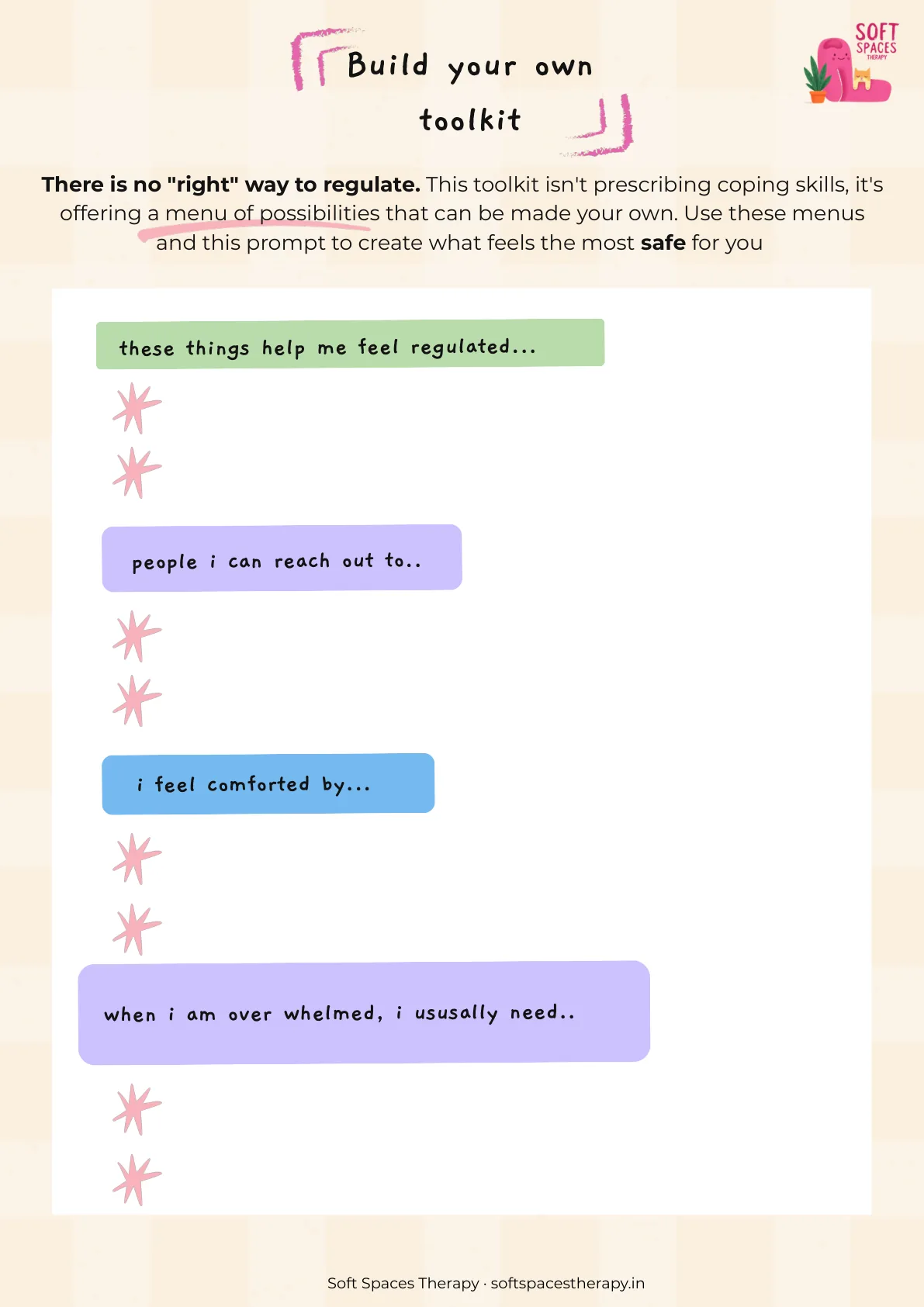
Build your own
toolkit
these things help me feel regulated...
people i can reach out to..
i feel comforted by...
when i am over whelmed, i ususally need..
There is no "right" way to regulate. This toolkit isn't prescribing coping skills, it's
offering a menu of possibilities that can be made your own. Use these menus
and this prompt to create what feels the most safe for you
Soft Spaces Therapy · softspacestherapy.in
NOTHING IS HELPING?
You don't have to navigate difficult moments alone. Reaching out
for support is one way of caring for yourself.
This toolkit is not a substitute for therapy, medical care, or the
support of trusted people in your life.
If you're feeling overwhelmed, please reach out to someone you
trust: a friend, family member, therapist, support worker, or
community member.
If you're experiencing intense distress, feel unable to keep yourself
safe, or are in crisis, please seek immediate support by contacting:
Soft Spaces Therapy: admin@softspacestherapy.in |
www.softspacestherapy.in
iCall (TISS): 9152987821· icallhelpline.org
Vandrevala Foundation (24/7): 1860-2662-345
The Humsafar Trust: 022-26673800 ·humsafar.info
iDREAM Project (trans-specific, legal support):
idreamproject.org
SAATHII (national): saathii.org
Want to explore therapy with us? Reach out at +91 91725 46738
Soft Spaces Therapy · softspacestherapy.in
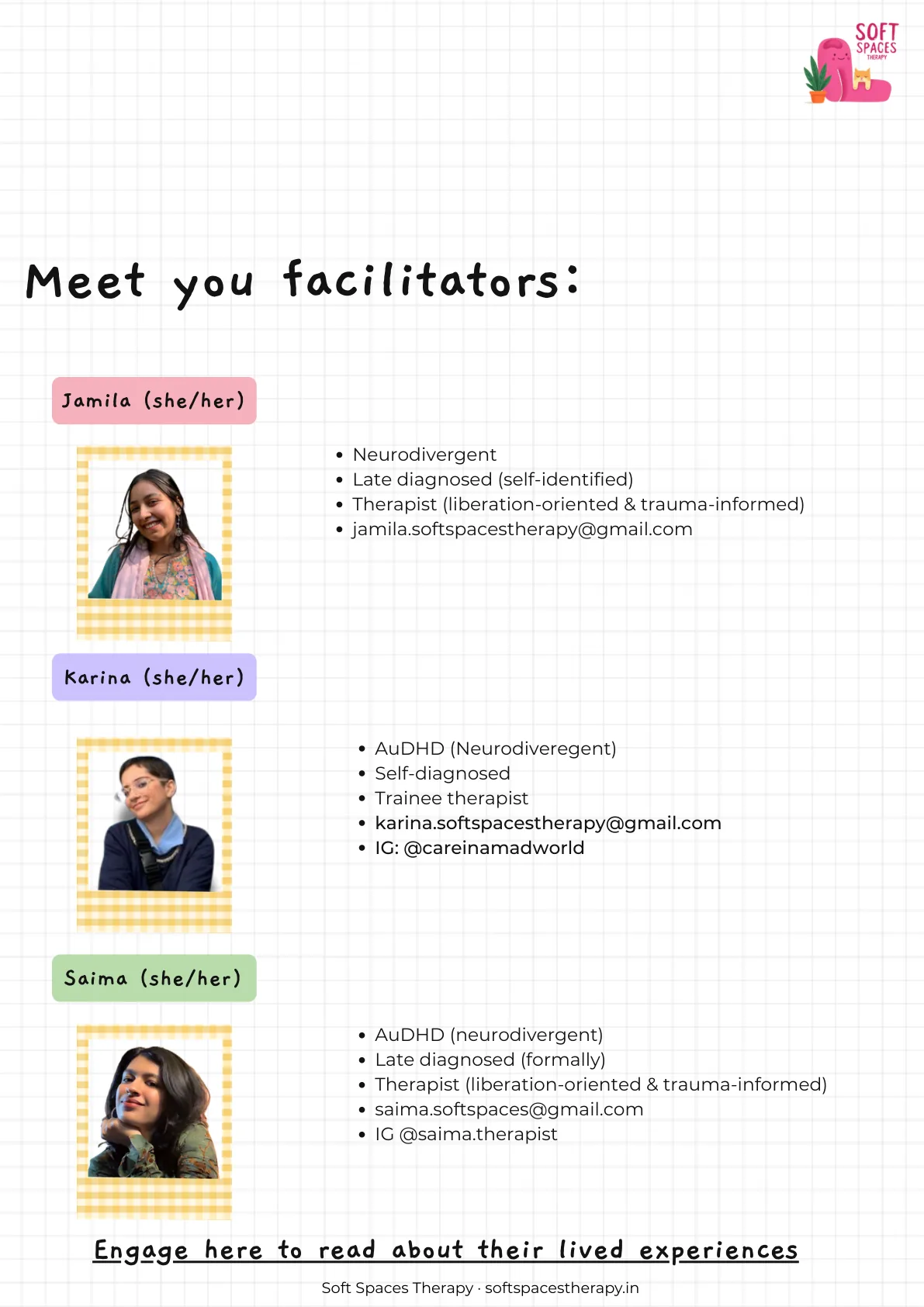
Jamila (she/her)
Karina (she/her)
Saima (she/her)
Meet you facilitators:
AuDHD (Neurodiveregent)
Self-diagnosed
Trainee therapist
karina.softspacestherapy@gmail.com
IG: @careinamadworld
Engage here to read about their lived experiences
Soft Spaces Therapy · softspacestherapy.in
AuDHD (neurodivergent)
Late diagnosed (formally)
Therapist (liberation-oriented & trauma-informed)
saima.softspaces@gmail.com
IG @saima.therapist
Neurodivergent
Late diagnosed (self-identified)
Therapist (liberation-oriented & trauma-informed)
jamila.softspacestherapy@gmail.com
THANK YOU
FOR TAKING THE TIME TO
EXPLORE THIS TOOLKIT.
FOR TAKING THE TIME TO
EXPLORE THIS TOOLKIT.
May you continue to honour your needs, celebrate your strengths, and
remember that you deserve spaces where you can simply be yourself.
We're rooting for you.
Always remember, there's no rush.
At our own pace. 🌼
© 2026 Soft Spaces Therapy | softspacestherapy.in
This resource is for personal use. Please do not reproduce
without permission.
Soft Spaces Therapy · softspacestherapy.in